State ignores election law with Sullivan ballot listing
The Alaska Supreme Court says that the Division of Elections cannot keep Dan “Senator” Sullivan off the ballot and it must follow the established rules in listing his name.
But the Division of Elections posted this sample ballot later Monday that does not follow the law in three ways—it ignores the candidate’s choice to be called Dan, refuses to list his Republican affiliation and refers to Sen. Dan Sullivan as the incumbent.
The state claim that only one candidate is eligible to be called Dan is absurd.
Don’t be surprised if there is more court action Tuesday to try to get the Division of Elections to follow the law.
The court issued its ruling Monday afternoon, upholding a Superior Court judge who ruled last week in favor of the Petersburg challenger, who is called “Senator” by his friends.
It was a sensible decision. It exposed a severe problem in the Division of Elections, where partisan politics and the power of incumbency have been allowed to dictate state policy.
The sample ballot issued by the state following the court order shows that Lt. Gov. Nancy Dahlstrom is continuing to take her marching orders from Sen. Dan Sullivan and the Republican Party.
Ohio Dan’s campaign said it was “encouraged” that the elections office would be able to “use its expertise” to differentiate between the candidates.
The state claim—pompously presented by an Outside lawyer—that Dan “Senator” Sullivan had no right to be a candidate because of his name, was laughed out of court.
The comedy may not be over, however.
Lawyers for the Southeast Sullivan had argued that the Supreme Court “should reject the Division’s new, invented out-of-whole-cloth fallback request that Mr. Sullivan be placed on the ballot as a Nonpartisan candidate and that Senator Sullivan be indicated as the incumbent, both of which violate Alaska law. The Division can avoid confusion by listing both candidates’ middle initials, referring to Mr. Sullivan as “Dan J. Sullivan,” (as it initially confirmed it would do) and to the incumbent Senator as “Dan. S. Sullivan.”
The court did not deal with this matter in its order Monday.
The state claimed that only the incumbent Sullivan should be allowed to call himself “Dan,” while the Petersburg Sullivan, who says he is known as Dan and as “Senator” Sullivan to his friends, should be Daniel.
The Supreme Court said that the division must act “within the confines of existing ballot design law.”
The existing ballot design law clearly forbids what the Division of Elections is proposing. The law has explicit instructions on how to deal with candidates of the same name, job titles, etc. and the state is not following the law.
“The director may not include on the ballot, as a part of a candidate's name, any honorary or assumed title or prefix but may include in the candidate's name any nickname or familiar form of a proper name of the candidate,” Alaska law says.
State regulations say “placement on the ballot for candidates sharing the same last name will be determined by those candidates' first name and, if necessary, middle initial. For example, under the ‘S’ placement, ‘Smith, John A.’ will appear before ‘Smith, Walter W.’ and ‘Smith, John A.’ will appear before ‘Smith, John L.’”
Your contributions help support independent analysis and political commentary by Alaska reporter and author Dermot Cole. Thank you for reading and for your support. Either click here to use PayPal or send checks to: Dermot Cole, Box 10673, Fairbanks, AK 99710-067?
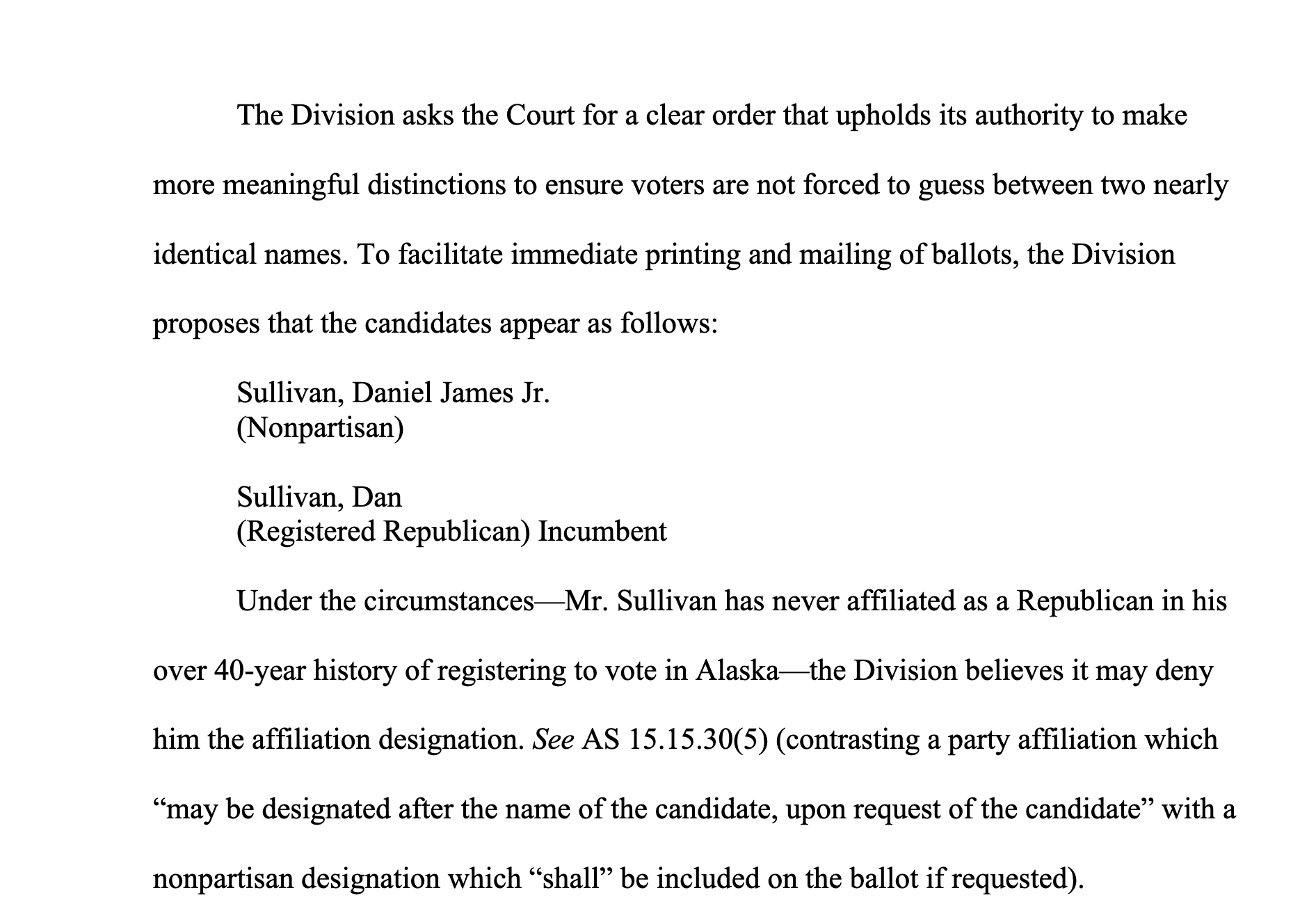
The state wants to list Dan “Senator” Sullivan of Petersburg as Daniel, a nonpartisan, while referring to Sen. Sullivan as an incumbent Republican. State law doesn’t allow what the Division of Elections proposed, however.