One Mahoney outlined benefits of closing Hilcorp loophole; Another Mahoney now objects
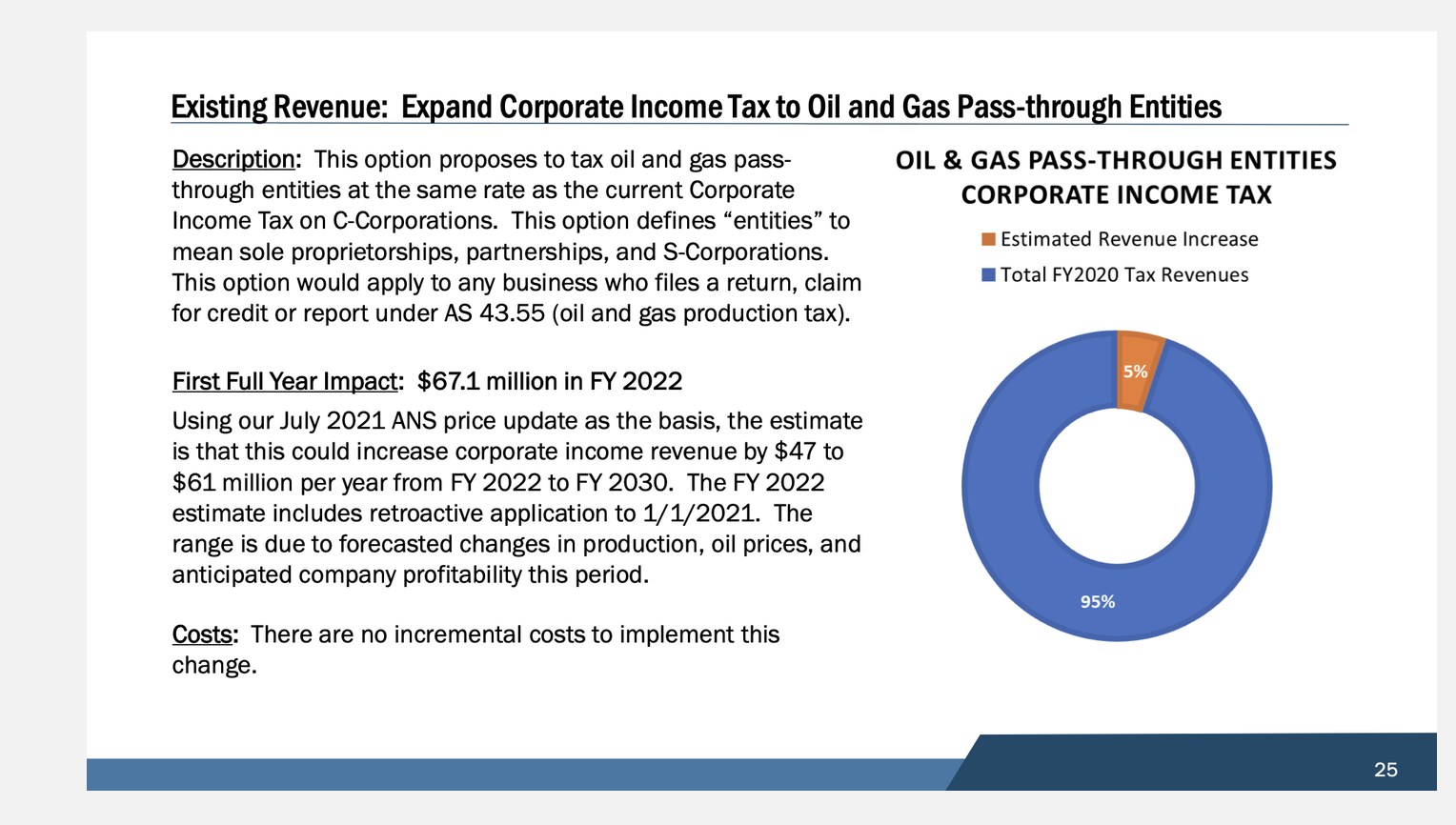
Revenue Commissioner Lucinda Mahoney presented a proposed tax on Hilcorp and other oil and gas “pass through” entities to the Legislature in 2021, saying it was supported by Gov. Mike Dunleavy.
Gov. Mike Dunleavy now claims that extending the corporate income tax to companies like Hilcorp and Glenfarne is a “poison pill” in the gas line bill.
Dunleavy never admits this, but he supported this idea five years ago and had his revenue commissioner testify to that support.
On Aug. 5, 2021 and again on Aug. 10, 2021, former Revenue Commissioner Lucinda Mahoney testified that Dunleavy would support ending the Hilcorp loophole and reducing the tax credit reduction if the Legislature approved them first.
She mentioned these two changes as among 10 revenue options “the governor would support as long as there was support from the Legislature,” Mahoney told lawmakers on Aug. 5, 2021.
A week later, she repeated the promise: “If the Legislature supports these measures, these are revenue measures that the governor would support as well.”
About ending the Hilcorp loophole, Mahoney acknowledged the disparity in how the state treated the giant oil companies. ConocoPhillips and ExxonMobil pay an oil company corporate income tax. Hilcorp does not because its owner uses a different business framework never envisioned for the Alaska oil industry giants.
“Some of our oil and gas producing companies are not paying corporate income tax due to the way that their legal structure is set up. We are proposing that those entities begin to pay the corporate income tax and establish parity between the oil industry,” Mahoney said two years ago.
Closing the Hilcorp loophole is long overdue to establish parity, while reducing the per-barrel tax credit is a minor change, as Mahoney said.
Asked by Rep. Jonathan Kreiss-Tomkins if the Department of Revenue had analyzed applying the income tax to all pass-through entities or just oil and gas companies as proposed in 2021.
“We have done that analysis. However, at this point this particular revenue measure is just addressing oil and gas and it’s more in a manner to establish revenue replacement and to establish parity between our operators and our owners in our oil fields,” she said.
In 2020, Mahoney said when Gov. Mike Dunleavy’s office called her to ask about naming her revenue commissioner, she immediately brought up the conflict of interest she had with her husband’s legal practice, representing the oil industry, and how it would be dealt with.
Her husband, F. Steven Mahoney, is a veteran lawyer who has represented oil companies in legal cases against the state and local governments. Lucinda said he divided his practice at Manley & Brautigam between work for nonprofits and work for oil companies.
Steven Mahoney has now been recruited by Glenfarne to oppose the proposal to tax companies like Glenfarne and Hilcorp.
On Saturday, he appeared before the conference committee on the gas pipeline to claim that the attempt to collected oil and gas taxes from companies like Glenfarne and Hilcorp was “rushed, targeted and volatile.”
He claimed the tax would not work in the way it is written. That the Dunleavy Department of Revenue did not do the work necessary to get all the details right is no surprise.

Mahoney said that if the tax implementation date was pushed for four years, that would given companies time to make decisions and adapt.
It is targeted and volatile, but not rushed. The language can be tightened and improved to make it work. The only certainty is that oil and gas companies will always oppose any tax increase.
As Rep. Bryce Edgmon asked Mahoney, is the opposition about the technical details. Or is really about opposing any and all taxes?
Adam Prestidge, the Glenfarne president, made it clear that the company opposed the income tax as a general rule, the standard position taken by industry.
“Last week Glenfarne put out a public statement articulating our views and our oppositions to the tax. I think first and foremost as Steve has said, Mr. Mahoney has said, we agree that certainty is a core driving principle for infrastructure development, infrastructure investment. And the presentation today has walked through some of the uncertainties that this creates. That’s certainly part of the opposition. The second point of opposition does go to the state comparison to, comparing Alaska as a state and a place where investors can decide to do business or not. With the Alaska LNG project, a $54 billion project, Alaska’s on the verge of one of the largest investment attraction, capital formation opportunities that any state has ever had. So undertaking that opportunity and that capital formation event and also layering in a tax regime that is uniquely higher than other states is incongruous and would really be defeating some of incredible opportunity for growth that the state has in front of it.”
“Sen. Stedman did ask Mr. Mahoney some of the ways that that could be ameliorated and Mr. Mahoney walked through some of those. But again those are two primary points of opposition for Glenfarne,” Prestidge said.
Speaking of certainty, Stedman made it clear that if the state does not collect an income tax from entities like Glenfarne, there would be great pressure on the day that a giant LNG project opens for the Legislature to slap a tax on it. The 9 percent tax looks a little high, Stedman said, but it wouldn’t be fair to wait and do nothing until the project is finished.
The state has to stay competitive and not price itself out of the world market.
Your contributions help support independent analysis and political commentary by Alaska reporter and author Dermot Cole. Thank you for reading and for your support. Either click here to use PayPal or send checks to: Dermot Cole, Box 10673, Fairbanks, AK 99710-067?