Matt Claman plans to vote for AG Cox, despite conflicts of interest
Anchorage Sen. Matt Claman, who still claims to be running for governor, long blocked legislative attempts to close the Hilcorp loophole, offering a wide variety of lame excuses.
Claman has also blocked plans to raise the age of consent from 16 to 18, offering excuses.
On Thursday, it appears he will vote to confirm Temporary Attorney General Stephen Cox, despite Cox’s shortcomings. I’m sure Claman will have an excuse or two.
Anchorage attorney Scott Kendall, a political insider who is a reliable source on these matters, wrote the following Wednesday about Claman’s plans to back Cox at the joint session Thursday.
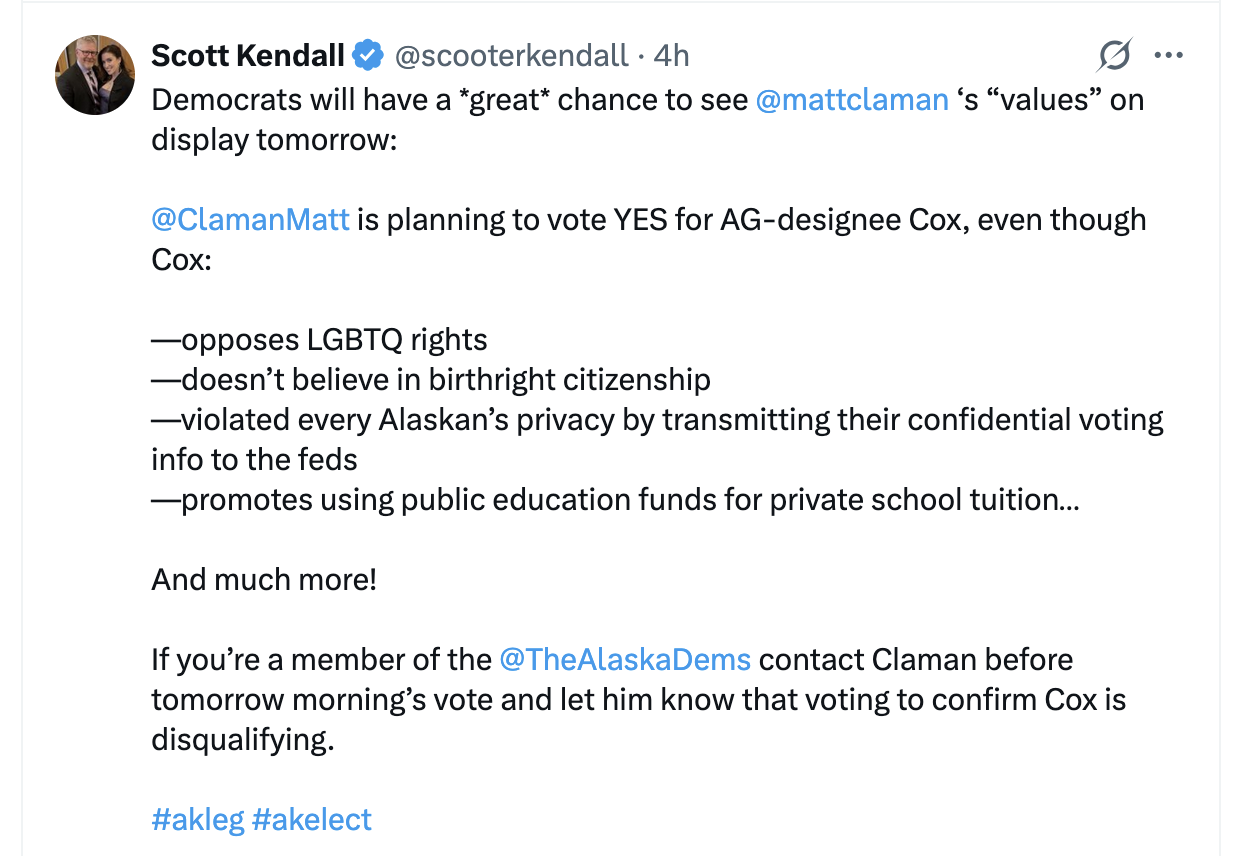
As to why Claman and others should oppose Cox’s confirmation, I think Kendall compiled a pretty good list.
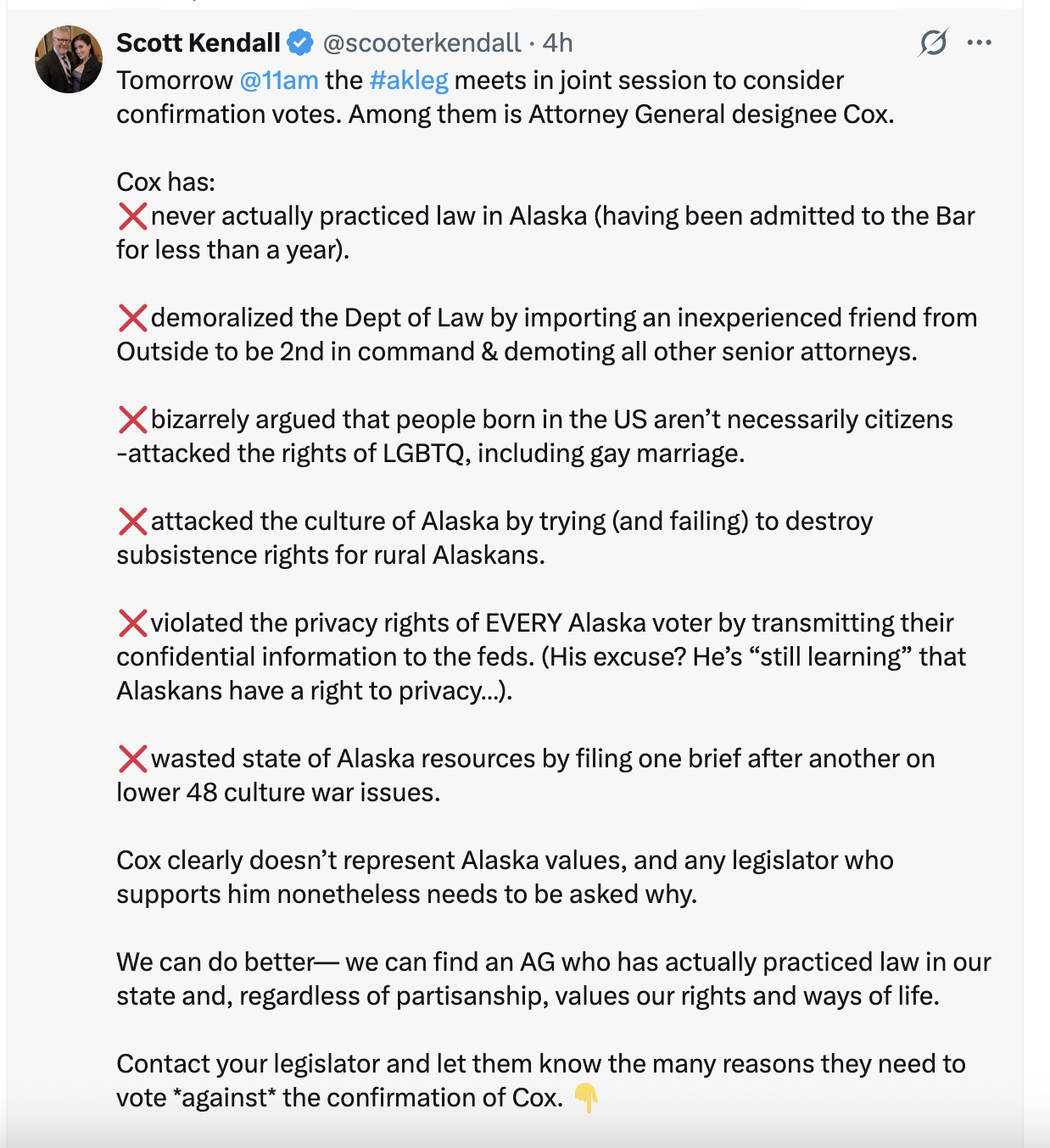
Here is a column I wrote earlier Wednesday about an aspect of Cox’s situation that has not been given a lot of coverage.
Temporary Attorney General Stephen Cox has conflicts of interest when it comes to public education in Alaska and the constitutional prohibition against using public funds for private schools.
“Our public schools are struggling,” Cox said on a Hillsdale College podcast when he was interviewed about how he and his wife had decided to start a private religious school in Anchorage.
“Test scores here have been reported to be ranking near the bottom nationally. In Anchorage there have been sort of a growing group of parents have been vocal about struggles and issues that they have about large bureaucratic schools. One-size-fits-all kind of approaches and even a breakdown in school culture and school discipline,” he told Scott Bertrand, the executive assistant to the provost at Hillsdale College.
Cox said that he and his wife Cristina decided in 2017, when they had preschoolers, that they wanted a private “classical education model” for their kids, when they lived in Alexandria, Virginia.
After they moved to Alaska from Texas in 2021, Cox said they spent a couple of winters before deciding in 2023 to organize a group of parents to start a private classical school, now named the Thomas More Classical School, which promotes itself as “Anchorage’s only Hillsdale K-12 American Classical Education supported effort,” set to open this fall.
“Education really should shape students’ minds and souls. And we wanted a school in Alaska that would revive the time-tested classical model of emphasizing great books, virtue and critical thinking. And also ground students in faith,” he said.
He said they chose the Hillsdale College K-12 model because Hillsdale has been the leader in this movement for decades and it has a proven model.
Cox’s podcast interview clarifies the depth of his conflict of interest when he inserted the attorney general’s office last fall into a dispute regarding a Hillsdale College pamphlet distributed to some Anchorage public school students. The document included the Hillsdale spin that “In recent decades, the way our government operates has departed from the Constitution.”
Cox dropped the matter with no apology when the emptiness of his allegations was exposed.
As to his beliefs about the Alaska Constitution and education, Cox mentioned something on the Hillsdale podcast that is really troubling.
When asked why he chose a private school instead of a charter school, he gave a long answer about his beliefs.
“We asked the question about charter school, like a tuition free charter school, or a private school. We chose the private path really to preserve our freedom and fidelity to our mission,” he said.
“Alaska’s charter framework, it brings really a lot of oversight. And really they’re few chartering authorities that can charter new schools. Here in Anchorage we would only be able to use, I believe, the Anchorage School District as a chartering authority. And there’s no appeal if they deny. And of course, there’s no room in a charter school, there’s no room for a faith-based identity. So as a charter we might not be able to pray, we might not be able to teach theology or fully integrate virtue and faith into the learning. And so going private really gives us complete freedom to uphold our Christian and classical mission,” he said.
All of that is fine. He has the right to promote private education and serve as attorney general.
But he didn’t stop there. What he said next gives me reason to question whether he supports the constitutional ban on using public funds for private schools.
“And then rather than waiting for years to, for Alaska’s laws to change that might afford more options on the charter front, we opted to do things our way through a private school,” he told the Hillsdale interviewer.
A couple of points here.
First, the Dunleavy administration is now claiming that any group that wants to open a charter school and fills out a charter application correctly must be approved. Presumably Cox had some role in creating that new legal position. For him to say there “is no appeal if they deny” contradicts what the Dunleavy administration claims.
Second, his comment about waiting for Alaska’s laws to change may either show a reluctance to support the language school funding in the Constitution or a belief that some entity other than the local school board should make charter school decisions.
During one of his confirmation hearings in the Senate, Cox said he did not know that his private school, of which he is the treasurer, had on its website this statement saying the school wanted to become a “vendor” with a public school district so that non-religious courses could qualify for state funds.
As the treasurer, Cox should have known that the school was telling parents of potential students something that is under a constitutional challenge. I find it hard to believe that the treasurer of a private school would not know about this key aspect of the institution’s proposed finances.
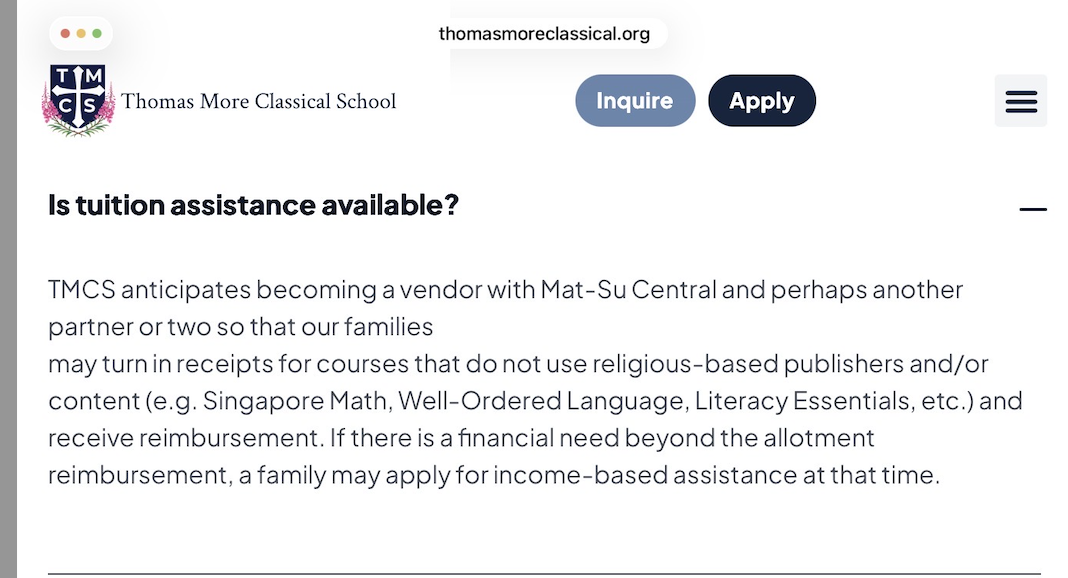
The school later changed the text after it became a point of contention in the confirmation hearing, to say the school would follow the law. The constitutional question and the conflict of interest remains.


The Alaska Beacon had the best coverage of this issue. There was little to no coverage elsewhere.
“I am on the board of that school. I am not involved in the day-to-day operations,” Cox said, adding that he was involved in hiring a headmaster and the formation of the school. “I am not aware of that part of the website and I’m also not aware of any decisions with respect to allotment programs.”
As the Beacon noted, “he declined to comment further saying the issue was in active litigation.”
Later, in a House confirmation hearing, Cox refused to promise to recuse himself from this issue, but said he would seek ethics advice.
That Cox doesn’t recognize his obvious conflict of interest and claims he needs ethics advice is another reason why he should not be confirmed.
The school board president of the private school founded by the Cox family is Charles Gartland, who is the civil division director in the Department of Law.
“Even if it’s all above board, as a member of the public, I see that, and I think that I would be more comfortable if the chairman of the board of a private school and the treasurer of the board of the private school wouldn’t work on those particular cases,” Anchorage Rep. Andrew Gray said.
Your contributions help support independent analysis and political commentary by Alaska reporter and author Dermot Cole. Thank you for reading and for your support. Either click here to use PayPal or send checks to: Dermot Cole, Box 10673, Fairbanks, AK 99710-0673.