Bill to collect tax on highly digitized businesses copies Dunleavy administration proposal from 2021
Sen. Bill Wielechowski is correct in saying it was the Dunleavy administration that came up with the idea for SB 113, which would change state law so that some tax income from businesses with more than half of their income online would be apportioned to Alaska.
“These reforms will have little, if any, effect on consumer prices for Alaskans. Online businesses usually set their prices at the national level and both market-based sourcing and single sales factor apportionment are increasingly common across the country,” Wielechowski said.
It’s not clear how much the bill would raise, but it would take a small bite out of Gov. Mike Dunleavy’s proposed deficit of nearly $2 billion.
“I can't take credit for this bill. This is not my bill,” Wielechowski testified Friday.
“This was actually a bill proposed by the Dunleavy administration a couple of years ago. And they proposed this idea to the fiscal policy working group,” he said.
On multiple occasions in 2021, Revenue Commissioner Lucinda Mahoney testified on the record that this tax was one of the measures that Gov. Mike Dunleavy promised to support if the Legislature enacted it.
Suzanne Downing, the blogger who speaks for the Alaska Republican Party, is lying when she claims that Wielechowski is not telling the truth about the origins of the bill.
Downing claims that Mahoney “discussed such a tax at a forum once,” but Dunleavy never supported the idea. It’s not true that this was something Mahoney mentioned once in passing at an alleged “forum.”
The record shows the idea for this bill came from the Dunleavy administration.
It studied the concept in great detail and drafted a bill on the topic that Wielechowski used as the model for his current proposal.
On Aug. 5, 2021 and again on Aug. 10, 2021, Mahoney testified that the tax on digitized businesses was one of numerous revenue measures that Dunleavy had agreed to support if the Legislature led the way.
She presented the list of options as those “the governor would support as long as there was support from the Legislature,” Mahoney told lawmakers on Aug. 5.
“All of these measures are measures that if the Legislature supports these measures, these are revenue measures that the governor would support as well,” she testified on Aug. 10, 2021.
The revenue measures the governor would support included a sales tax, closing the Hilcorp loophole, reducing the per barrel oil tax credit and others, she said.
On Aug. 12, 2021, Dunleavy told a public radio interviewer that his administration had put together options “for people to look at in the Legislature, but they're the ones that have to come up with the options and the mix that they think will work if they need revenue.”
He said he would veto any tax without a constitutional amendment, however, to limit spending. The Legislature did not approve any of the tax proposals.
In a followup 9-page letter on October 1, 2021 to legislators, Mahoney gave many specifics about why the administration supported the idea.
“DOR’s proposal is to update Alaska’s existing Corporate Income Tax by creating a modified apportionment methodology for highly digitized businesses in an effort to better reflect the way these types of businesses generate taxable income,” she said.
“Instead of using the standard three factor formula (sales, property, and payroll) that most other corporate income tax taxpayers use, highly digitized businesses would use a single sales factor formula. According to the Tax Foundation, over the past few years, many states have increased the weight of the sales factor, with 29 states relying on it completely.”
“While other states that impose Corporate Income Taxes do not have modified apportionment formulas specific to highly digitized businesses (like what DOR is proposing), some have adopted the market based sourcing and other rules (like what DOR is proposing), which captures some of the income generated from digital goods and services. Moreover, this methodology proposed by DOR has been reviewed and supported by the Multistate Tax Compact as well as this Administration’s Tax consultant, Joe Crosby.”
“DOR’s proposal also includes a 10% surcharge for highly digitized businesses, which is intended to be a compensatory tax meant to compensate the state for lost tax revenue that these companies would have otherwise paid the state if they were traditional brick and mortar businesses. Traditional brick and mortar businesses not only pay Alaska Corporate Income Tax, but they also pay a variety of payroll taxes, local property taxes, business registration and license fees, and motor fuel taxes, to name a few,” she wrote.
“While highly digitized businesses may not be physically present in Alaska per se, they still use our local resources. For example, delivery of goods by common carrier burdens our local roads, airports, ports, and fire and law enforcement services. Disputes involving highly digitized businesses burden our court system (debt collection, liens, other contract disputes) and process servers. Warranty services are often performed by local contractors. Product returns can be arranged through local agents (e.g. a highly digitized business may use an unrelated retailer as an agent for product returns). And software downloads and data streaming burden our infrastructure such as network servers, cables, wireless towers, and related personnel to construct and/or maintain facilities/towers.”
Mahoney remained on the job as revenue commissioner for about a year after that letter. “I want to acknowledge and celebrate Commissioner Mahoney’s many contributions to the people of Alaska,” Dunleavy said when she resigned on Sept. 2, 2022.
Your contributions help support independent analysis and political commentary by Alaska reporter and author Dermot Cole. Thank you for reading and for your support. Either click here to use PayPal or send checks to: Dermot Cole, Box 10673, Fairbanks, AK 99710-0673.
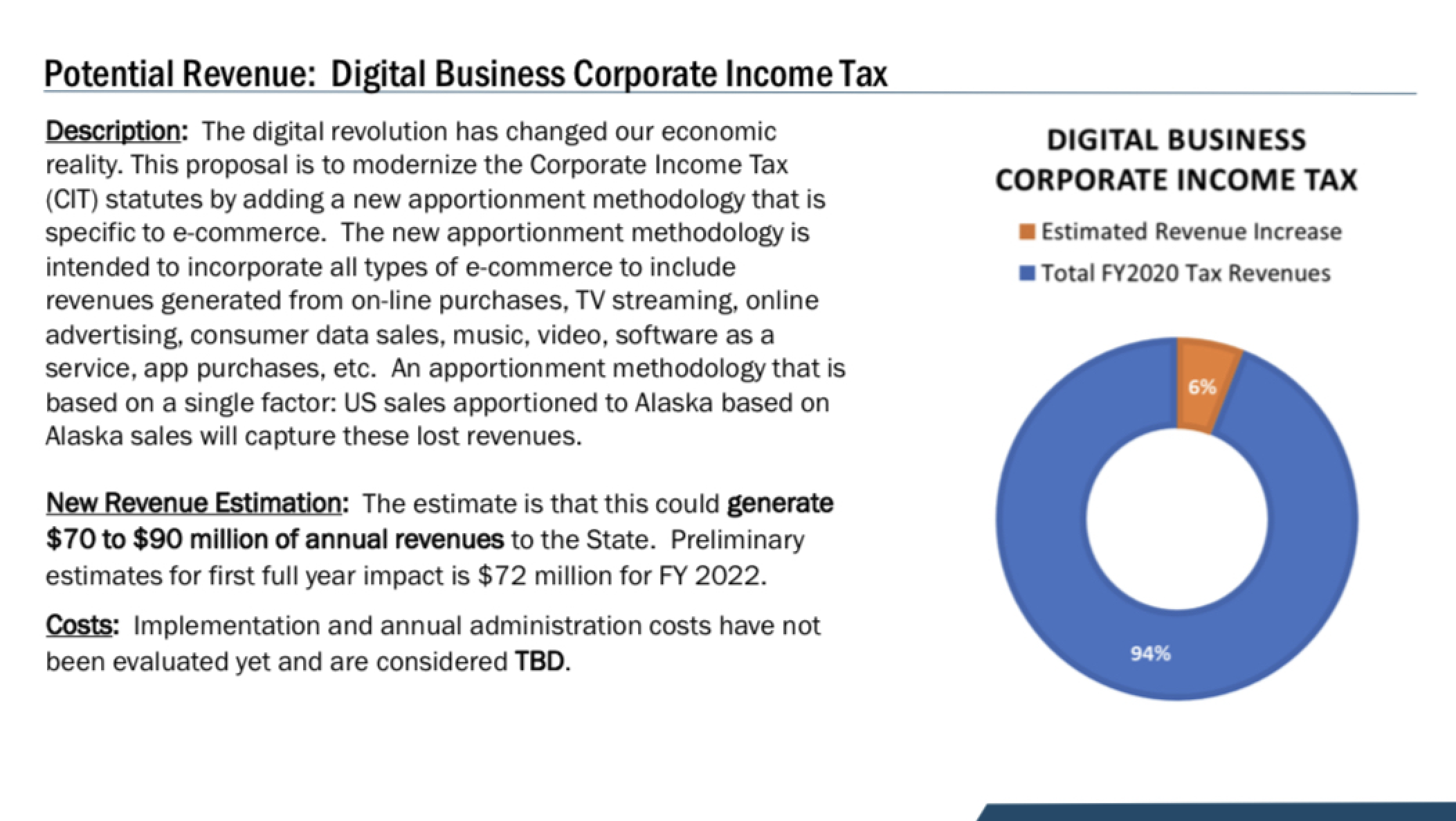
This is the proposal the Dunleavy administration made to legislators in 2021 to allow the state to collect some of the tax money on digitized businesses that is now going to other states.
