Leaky vessel for pipeline dream
Craig Compeau, stalwart Dunleavy defender, repeated the simplistic tenets of the “Build the Line!” propaganda campaign in an opinion column published by the Daily News-Miner.
Jim Plaquet did the same a few days ago in a letter claiming that, “The economics didn’t kill this opportunity. Our liberal Interior legislators — Scott Kawasaki, Maxine Dibert and Ashley Carrick — did.”
That’s not what happened.
The Republican talking point in Alaska is that Democrats in the Legislature and a handful of Republicans, including Sen. Cathy Giessel and Sen. Bert Stedman, are the only thing standing between us and a world of cheap energy from the North Slope.
The situation is far more complicated than the “Build the Line!” brigade would have us believe.
The experience of the past year-and-a-half points to a series of red flags that went unheeded by Alaskans.
The uncomfortable truth is that Glenfarne was never the right company to plan and execute one of the world’s largest construction projects.
The underlying problems are poor planning, untested assumptions and false expectations raised by Dunleavy, the Alaska Gasline Development Corporation, Sen. Dan Sullivan and Glenfarne.
The changing claims from Dunleavy, AGDC, Sullivan and Glenfarne on the property tax question between the spring of 2025 and today should make everyone question why no one had thought all of this through in a disciplined manner.
Warning signs
Glenfarne entered the pipeline planning with AGDC in early 2025 asking for a $50 million money-back guarantee. It wanted the guarantee in case it decided that it could not go forward. We still don’t know why the company was so unsure that it needed this backstop. And why AGDC concluded that the $50 million payback plan was essential.
Overwhelming legislative opposition killed the $50 million guarantee. The AGDC deal with Glenfarne remains secret.
In the meantime, Donald Trump had announced an imaginary joint venture with Japan and South Korea to build the pipeline. Dunleavy claimed this would ensure construction.
Dunleavy, along with Sullivan and Rep. Nick Begich the Third were completely taken in by Trump’s attempt to use bluster to build the dream project. They swallowed the notion that Japan and Korea would be forced by Trump to bankroll what Sullivan tried to brand as “America’s Gasline.”
High on Trump gasline euphoria, they assumed that things like the state law on property tax was not an immediate problem.
On April 9, 2025, AGDC President Frank Richards told the Legislative Budget & Audit Committee that a state property tax cut would be good for the economics of the pipeline, as a consultant had found, but Glenfarne was not asking for a property tax cut.
“There’s no consideration for property taxes. The existing statutes are what are in place and will be abided by,” Richards testified.
Speaking at his 2025 energy conference, Dunleavy said his dream for the year ahead was to see agreements signed, pipe ordered and “getting this project ready to roll.” He didn’t mention a tax cut.
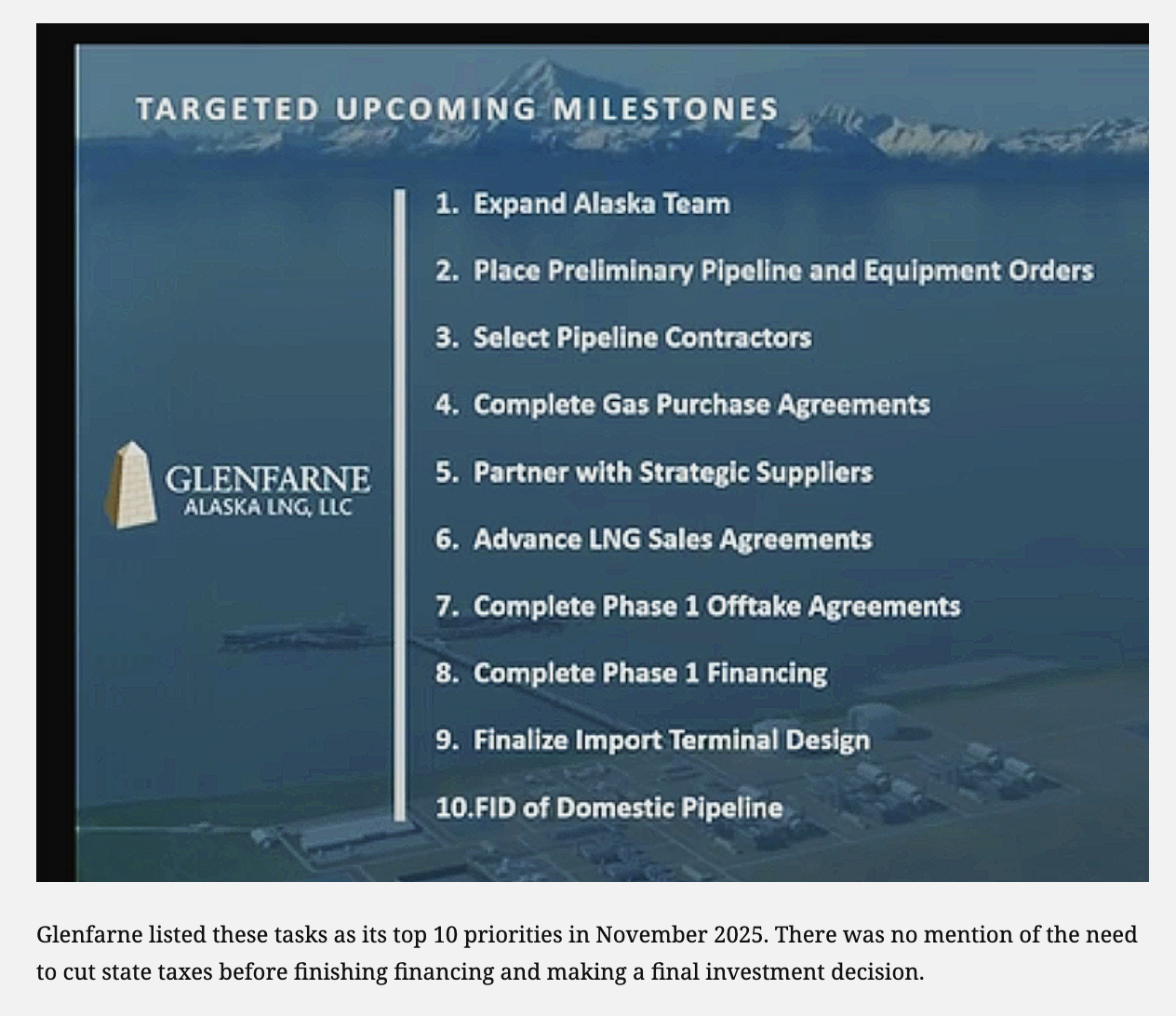
Duval, the CEO of Glenfarne, showed a slide to the Resource Development Council on November 12, 2025 listing the top 10 upcoming milestones for the Alaska LNG project. A property tax cut was not on the list.
That same day Dunleavy compared those who questioned the pipeline’s prospects to Doubting Thomas.
“There’s some incredible announcements that are going to be made over the next two months that I think will prove what I just said to be correct,” Dunleavy said.
Had Glenfarne, AGDC, Sullivan, Begich and Dunleavy conducted due diligence, they would have mentioned that a property tax change would be essential before anyone reached a final investment decision. But they failed to do so.
On November 19, 2025, a legislative consultant testified about things the state had to clarify before a company could commit to building a pipeline.
Nick Fulford presented the slide below about the various tasks ahead. Questioned by Sen. Cathy Giessel, he said he knew of no legislation planned by Dunleavy to resolve these questions.
There was no specific plan from Dunleavy or Glenfarne for the Legislature to reduce the property tax, a levy that made sense with oil, a higher priced commodity, but not with natural gas.
The need for a change in property taxes for a gas pipeline had long been discussed, but the Dunleavy administration, AGDC, Sullivan and Glenfarne never made that a priority in 2025. They never mentioned that it had to happen or else.
To me this is the biggest clue that Glenfarne has never been the proper vessel for Alaska’s pipeline dreams.
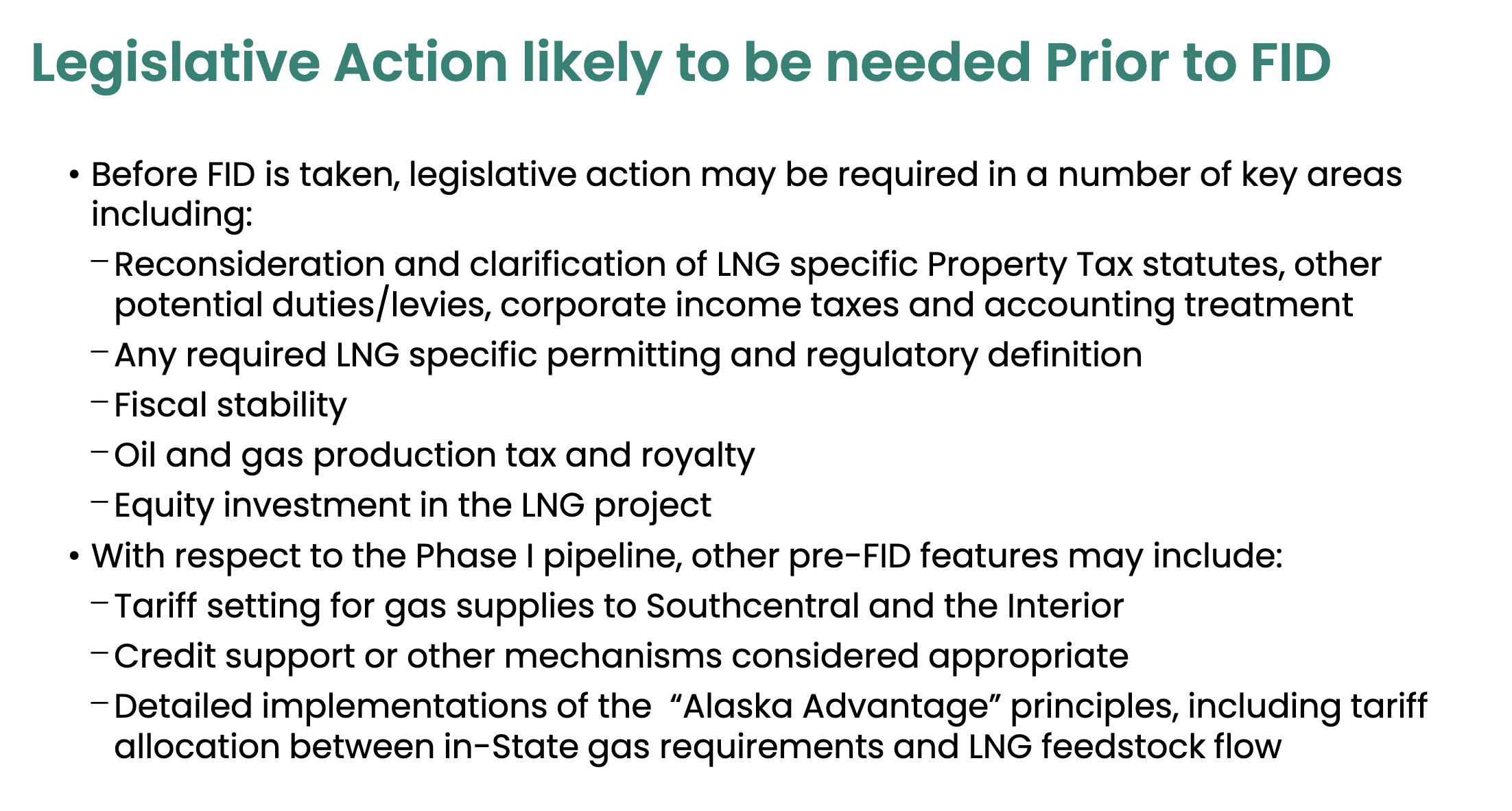
A legislative consultant presented this slide on November 19, 2025 to the Legislative Budget & Audit Commitee. Ten days later in Fairbanks, Dunleavy said Glenfarne would advance to a final investment decision in January without any legislative action.
One of the biggest promoters of the “Build the Line!” propaganda campaign is Glenfarne, which runs the Alaska LNG Facebook page.
On that page, Glenfarne public relations men Tim Fitzpatrick claimed on August 19 that Glenfarne told the Legislature in 2025 what needed to be done: “Alaska’s uncompetitive tax structure has been a known problem to the Legislature for more than a decade. Glenfarne told the Legislature last year that this was a significant barrier to development.”
If Glenfarne did tell the Legislature that it needed the tax cut before making a final investment decision, the company should prove it. I have found no indication that Glenfarne ever told legislators in 2025 that it needed the tax break before going ahead.
What Glenfarne President Adam Prestidge told legislators November 19 was that the company would order pipe in early 2026, spending hundreds of millions without legislative approval on a tax cut.
“In the very near term, we will also be commencing steel production and place purchase orders for hundreds of millions of dollars of steel that will be carried out by domestic and global steel mills and pipe mills, and delivered here into Alaska,” Prestidge told the Legislative Budget & Audit Committee that day.
“The initial early works, including the pipe purchases, will be funded by Glenfarne,” said Prestidge.
“They are frankly more risky because there are assumptions that will be made and parts of the ultimate project package that need to be finalized, but I think our level of optimism in the project will justify making those expenditures,” he said.
On November 29, 2025, Dunleavy said much the same thing at a Fairbanks fundraiser for Rep. Frank Tomaszewski.
Glenfarne had assured him that there was nothing the Legislature needed to do before the company advanced to a final investment decision, Dunleavy said.
“I talk with Glenfarne every week. I talk with the president and his people often. Everyone is excited about where this pipeline is gonna go. In terms of it’s gonna happen,” Dunleavy said.
“And then FID, what they call final investment decision, will be January. Spoken to them again yesterday, they see nothing standing in the way. So when February, or when January comes, you’re probably gonna see an announcement before the end of January that they’re gonna start to order pipe. And it’ll be here by August of this next year,” Dunleavy said last November. “So you will have gas.”
A little more than two weeks later, Dunleavy had a completely different opinion about what had to happen first to move the project forward.
It was on December 16, 2025 that the Anchorage Daily News reported that Dunleavy would ask the Legislature to cut property tax on the proposed project. Legislators would have to roll up their sleeves and get serious, he said.
Your contributions help support independent analysis and political commentary by Alaska reporter and author Dermot Cole. Thank you for reading and for your support. Either click here to use PayPal or send checks to: Dermot Cole, Box 10673, Fairbanks, AK 99710-0673.