
Court rejects Pearl Creek school opening
Fairbanks Superior Court Judge Kirk Schwalm rejected efforts by the proposed Pearl Creek charter school for a court order requiring the school district to allow the charter to open in August.
The Pearl Creek group requested a preliminary injunction to order that the school be opened while court proceedings continue regarding the school district challenge to the process used by the Dunleavy administration.
Here is the request for the preliminary injunction and background documents.
The district has argued that opening the school in August would create chaos in other schools.
“Forcing the District to provide services and supports to achieve the hurried opening of a new charter school in 2026–2027 would likely create staffing instability across the district. It would increase the number of positions to be filled, trigger additional vacancy processes, place added burdens on principals and hiring teams, and heighten the risk of unfilled positions at existing schools. At a time when the district is already facing staffing shortages, establishing a new charter school would make it more difficult to ensure that every school is appropriately staffed and ready to serve students at the start of the school year,” the district said.
Schwalm wrote that there would not be “irreparable harm” if the charter does not open, while he said the financial impact on the district would be about $2 million. The district had estimated the cost at more than $2.3 million.
The charter advocates first asked for an order saying that the school district must negotiate with Pearl Creek, but that was revised to seek an order that the district “enter into Pearl Creek’s proposed contract,” the judge said.
One of the key issues is what would happen to staffing and operations at existing neighborhood schools—including Anne Wien, Woodriver and University Park. About 230 students would move from neighborhood schools to the charter.
Services brought back to those schools under the latest budget would have to be cut if Pearl Creek opened in August, the judge said.
“The School Board found that establishment of the proposed charter school would be expected to lead to cuts in classroom teacher positions at neighborhood schools and could ultimately require the closure of one or more additional neighborhood schools,” the school district argued in its request to deny the preliminary injunction.
Schwalm said the Pearl Creek proponents did not make a showing of “probably success on the merits of the dispute” to justify a preliminary injunction.
This is the first instance in which a charter school rejected by a local school board has been approved by the state.
“It is unclear what constitutes legally permissible reasons to deny or grant an application for a charter school,” he wrote. “It is unclear whether the commissioner’s designee and the state board based their decisions on the proper record.”
Mike Kramer, the attorney for the Pearl Creek group, took me to task in a comment on another blog post and said I am wrong in saying the state claims that any charter application filled out correctly must be approved.
“You also keep reporting that the state board merely confirmed that the charter application was complete with no real analysis of the contents of the application, but you have never reported that the state board incorporated the very thorough factual and legal analysis previously performed by the State Department of Education and Early Development,” said Kramer.
“It is misleading to claim that the only reason the state board approved the charter is because all the boxes were checked on the application. DEED recommended approval of the charter because all of the reasons provided by the District for denial were unsupported by evidence and/or contrary to law.”
As I first said here April 29, “Hidden within the clumsy text is the Dunleavy claim that any and all charter school applications must by approved by local school boards if the applications are filled out properly.”
In rejecting the Pearl Creek application, the school board found that it would have a negative impact on overall district finances and would probably not succeed.
“Alaska law does not require charter school applicants to demonstrate either that a proposed charter school would not negatively impact a school district’s finances or that the school has a likelihood of success,” Preziosi said.
And it follows, according to the Preziosi analysis, that it is against the law for the school district to reject a charter application on grounds that it would harm the district’s finances and that the application “does not demonstrate a likelihood of success. . .”
The state is wrong. The district has a responsibility to consider the financial impact of a charter school and its chances for succeed.
That document was followed by a state school board review that was even worse.
“The budget summary and financial plan provided by Pearl Creek in its initial charter school application appears to provide financial and budgetary information to the extent possible given the information available to Pearl Creek,” the state board of education said.
“Additional information from the district appears to be necessary in order for Pearl Creek to provide more extensive information related to the budget summary and financial plan,” Dunleavy’s hand-picked state board members said.
The board concluded in two paragraphs that the finances appeared to be great, though it did not bother to test any assertions, assumptions or check the numbers. It’s no wonder the board members never voted on their findings in public.
Your contributions help support independent analysis and political commentary by Alaska reporter and author Dermot Cole. Thank you for reading and for your support. Either click here to use PayPal or send checks to: Dermot Cole, Box 10673, Fairbanks, AK 99710-067
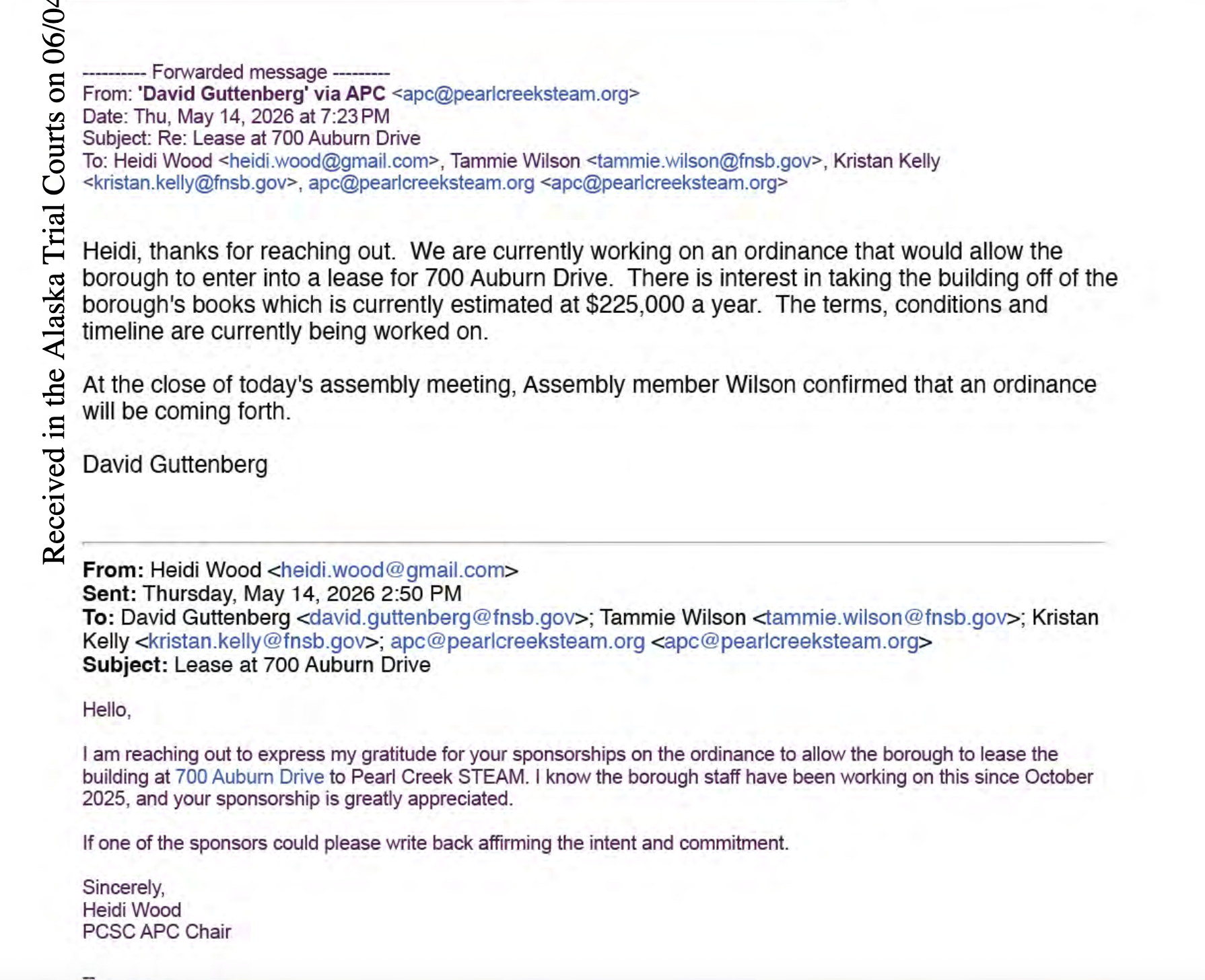
The borough assembly has a special meeting Thursday to introduce an ordinance regarding the lease of the old Pearl Creek building to the charter school proponents. The court ruling Wednesday rejecting a preliminary injunction to open the school adds more uncertainty. The emails above were included as footnotes in the request for a preliminary injunction to show support for the charter school from the borough assembly.