Glenfarne should get no tax break unless Fairbanks gets a pipeline connection
The Dunleavy administration is now saying that a gas line spur to connect Fairbanks to the proposed LNG export project would cost about $250 million.
Fairbanks consumers and utilities would have to pay the $250 million under the scheme that Gov. Mike Dunleavy and the Alaska Gasline Development Corporation have promoted for years.
The plan to exclude Fairbanks goes back to Gov. Sean Parnell and the pipeline route that was chosen to pass just west of the boundary of the Fairbanks North Star Borough.
Dunleavy and the current incarnation of the AGDC claim that history is on their side and that Fairbanks should be forced to pay for a 40-mile connection to the pipeline. The Fairbanks link is not part of the overall project only because Dunleavy and the AGDC claim that is the case.
They are wrong.
Fairbanks consumers should not be forced to pick up the entire tap just because pipeline planners decided that was the best option more than a decade ago. It was never the best option.
“They have not given any defense, other than it was not part of the original SB138 in 2014,” said Sen. Scott Kawasaki, who opposed the 2014 bill for failing to address the Fairbanks connection.
This overall LNG export project, which is supposed to cost $50 billion or more—the latest estimate is being secret by Glenfarne—should include the cost of the Fairbanks connection.
The project is dependent on getting Japan, Korea, Taiwan, Thailand and other countries to sign 20-year contracts for enormous amounts of Alaska gas. A tiny segment would go to Fairbanks.
This assumption by statewide politicians that Fairbanks can pay for the spur line itself has never been seriously challenged under previous episodes of the state pipe dream.
I was glad to hear testimony Tuesday before the Senate Resources Committee from Adam Prestidge, the president of Glenfane Alaska, that the company now supports including the Fairbanks spur line as part of the overall project with certain conditions. He did not identify the conditions.
This comes just as both the Senate and House revisions to the Dunleavy gas line plan would require the project to include the spur line as part of the project.
“A gas pipeline advanced, operated, or owned, in whole or in part, by the corporation, or a subsidiary of the corporation, must include a direct spur line to serve the City of Fairbanks and the Fairbanks North Star Borough,” the Senate Resources Committee version says.
The AGDC board should have stepped in long ago to straighten this out and mandate that if the LNG project goes forward, it should include Fairbanks.
The AGDC board and Dunleavy have failed to do anything, however.
In fact, they are still kicking about the Fairbanks connection and claim that it would take a separate capital budget appropriation of nearly $250 million to provide gas to Fairbanks.
“It is like the AGDC and the AKLNG doesn’t even care about making natural gas available to anyone except the LNG export market,” said Kawasaki.
The AGDC claims that the spur “is not part of the project.” This reflects the failure to recognize the needs of the Fairbanks area.
Glenfarne should get no tax break unless the Fairbanks spur line is included in the project.
Your contributions help support independent analysis and political commentary by Alaska reporter and author Dermot Cole. Thank you for reading and for your support. Either click here to use PayPal or send checks to: Dermot Cole, Box 10673, Fairbanks, AK 99710-0673.
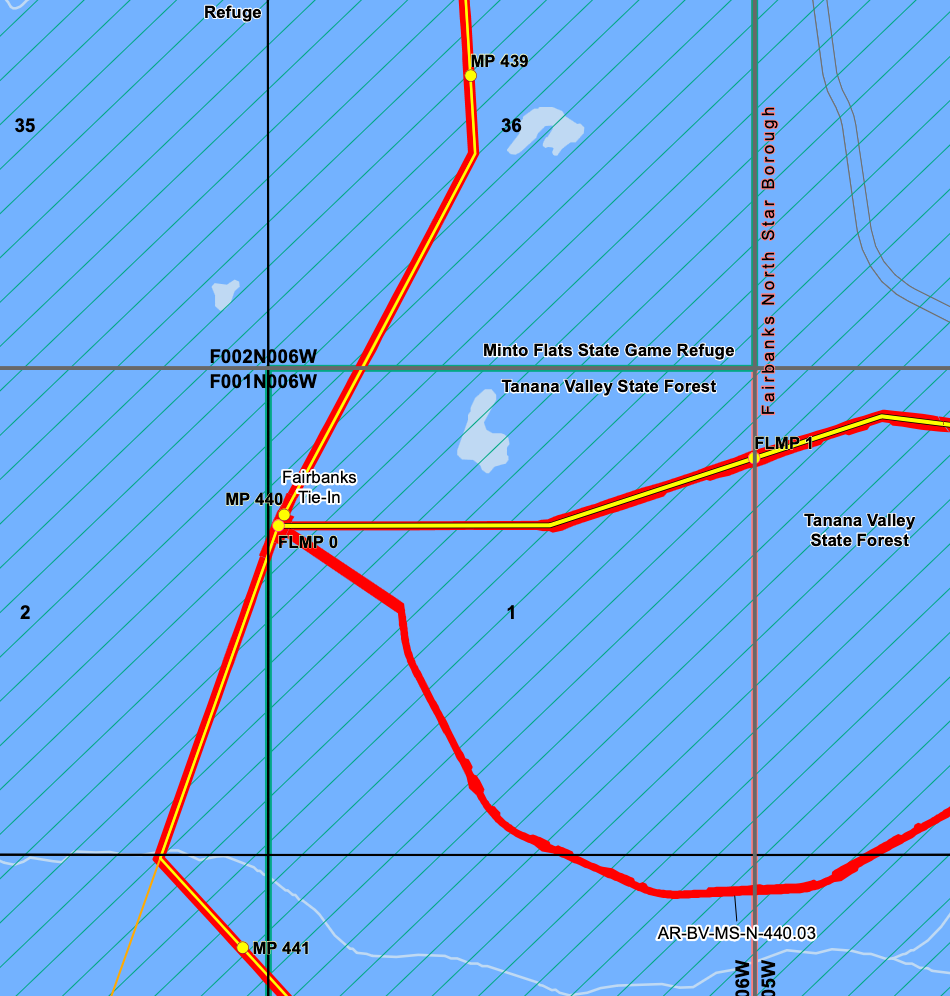
The proposed pipeline route passes just west of the boundary of the Fairbanks borough and does not include a Fairbanks “tie-in” that would run 40 miles east, now estimated to cost $250 million.