Dunleavy lobbyist Mark Begich evades the Glenfarne flip-flop on property taxes
The video accurately reflects the hard sell by Dunleavy, Glenfarne, many Republican legislators and business groups now shouting that the project will only be built if the Legislature provides something close to Dunleavy’s proposed 90 percent property tax cut.
But the video is misleading.
It’s most notable for what Begich failed to reveal, which is that a year ago, no one was saying the Legislature had to cut property taxes or else. And six months ago Dunleavy and Glenfrane did not say that the Legislature had to cut property taxes or else.
“I believe you’re going to see a gasline,” Dunleavy said on November 12, 2025 to the RDC, a month before he changed his position on taxes.
“There’s some incredible announcements that are going to be made over the next two months that I think will prove what I just said to be correct,” Dunleavy said, adding that he realized not everyone was a believer.
“There are still some folks that doubt this. And I understand that. Thomas doubted the risen Jesus and had to put his fingers in the palms of Jesus to really understand that that was a reality. I’m not comparing a pipeline potential with Jesus but I am saying that we have some incredible opportunity,” Dunleavy said.
Brendan Duval, the CEO of Glenfarne, showed a slide to the audience on November 12, 2025 labeled “targeted upcoming milestones.”
None of the 10 milestones had anything to do with getting the Legislature to lower property taxes by 90 percent.
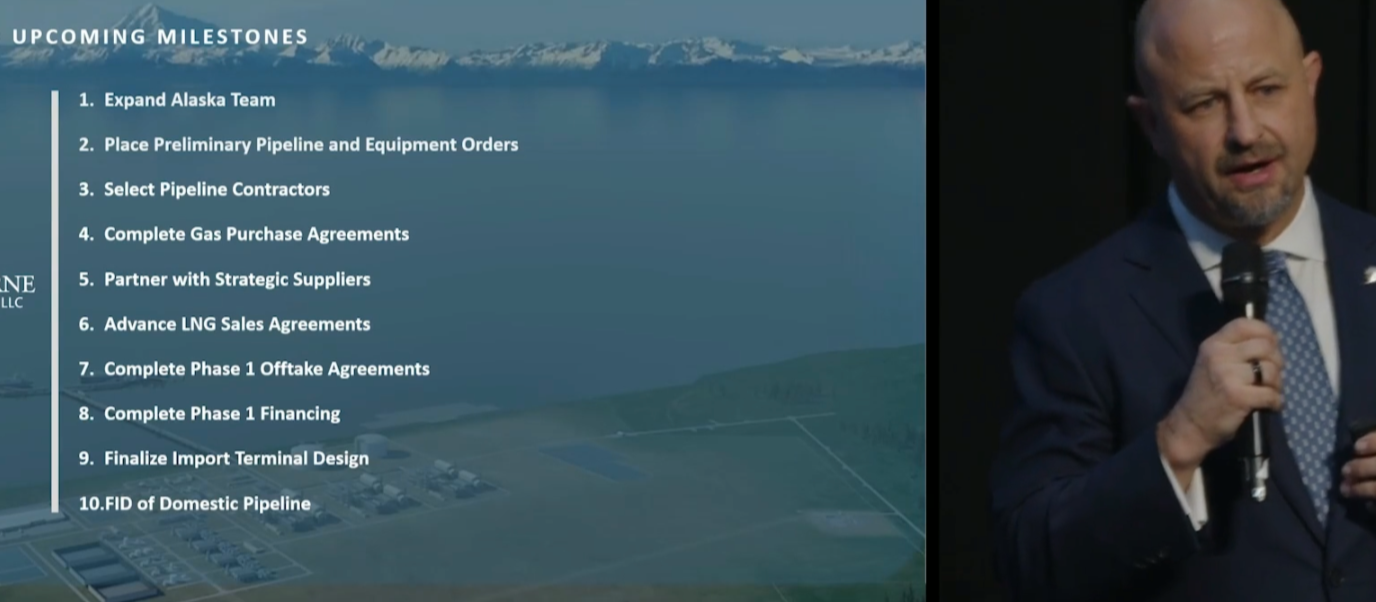
Brendan Duval, the CEO and founder of Glenfarne, presented this list of 10 “upcoming milestones” on November 12, 2025. It was only later that Dunleavy and Glenfarne added a 90 percent property tax cut to the top 10 list of milestones.
On October 16, 2025, Dunleavy told the RDC about how he had turned from a doubter into a true believer.
“I have to tell you, it is, it’s the real deal. I would be shocked, shocked, not surprised, shocked, if in December, January, than there’s anything other than we’re going to FID (final investment decision) and year year (2026) when we have this conference, there will be pipe on the ground and pipe actually moving. So that’s the, that’s the future,” Dunleavy said seven months ago.
Those are not the words of someone who needed a 90 percent property tax cut to avoid being shocked or surprised.
It is impossible to reconcile what Dunleavy and Duval said in November with what they said in December and what they say now.
(There was a legislative hearing on November 19 at which legislative consultant GaffneyCline raised the property tax issue. Did Glenfarne, in updating the cost of the pipeline, discover that the price, which it won’t reveal, is too high? GaffneyCline insists that its owner, Baker Hughes, becoming a partner with Glenfarne last November had no influence on its recommendations.)
More transparency is required on all of this. Disclosure should be the first committee demand of the special session this week in the House and Senate.
Dunleavy, Glenfarne, AGDC and Begich have not admitted that in the closing weeks of 2025 their positions changed, and the tax cut that no one had asked for became an essential prerequisite to building a pipeline. This damages their credibility.
Ignoring the questions will not make them go away.
Duval told Dunleravy’s 2026 energy conference last week that financing of the Alaska LNG project now depends upon “a form of this tax abatement, stabilization arrangement that is being negotiated in Juneau. That’s a critical condition.” He proposed a “call to arms” to lobby the Legislature for the tax cut.
As the 2026 regular legislative session neared an end, Begich told the RDC that there will be no pipeline without a tax break and he complained about why some legislators have failed to grasp the financial reality.
“One thing we know based on legislative reports, governor reports, AGDC’s reports, independent reports—our property taxes on oil and gas is too high compared to any other jurisdiction that we are competing against,” said Begich.
“They all recommended—lower it. It is an impediment. OK? Only thing being asked by the Legislature on this. Oh by the way, they (the state) don’t get any property tax. They don’t get any $100 million if the project doesn’t happen.”
Early this month, Begich went on about the nature of the disagreement with some legislators:
“So we’re starting from ground zero. So we don’t have it. Their argument is, ‘Well, what is it we get it?’ Well, but you don’t have it. That’s the point. We’re trying to create the project and fiscal conditions are part of it. And fiscal certainty is part of it. And this is the only fiscal certainty they’re asking for,” he said.
“This is to me, Oh my God, easy. Piece of cake. Not so much now,” he said.
Begich, Dunleavy, Glenfarne and anyone else confronted by doubting Thomases should start by explaining why they decided last December that a property tax cut was essential, after claiming otherwise since Glenfarne signed on in March 2025.
Your contributions help support independent analysis and political commentary by Alaska reporter and author Dermot Cole. Thank you for reading and for your support. Either click here to use PayPal or send checks to: Dermot Cole, Box 10673, Fairbanks, AK 99710-0673.