
Three days before quitting, Crum moved $225 million for 3 long-term investments
It’s a good sign that Sen. Bert Stedman is planning to hold public hearings on former Revenue Commissioner Adam Crum’s ill-conceived attempt to take $225 million of public funds that might be needed soon and lock it up for years.
The public has not been given a clear picture of this irresponsible action.
The news reporting has been incomplete and unfocused.
There are also people such as Suzanne Downing who are regurgitating false claims from Crum, who is trying to preserve his campaign for governor by claiming this was a great achievement, not a debacle.
Today we’ll look at the amount of money involved.
The news accounts that say this is about a $75 million proposition with DigitalBridge fail to make clear that this was a $225 million effort by Crum that he pursued in a reckless manner. He claimed he had been working on this for a year, but he ignored normal procedures to avoid dealing with those who objected to his idea.
On August 5, three days before Crum left his state job, he set final plans in motion to invest $225 million with three private equity companies—DigitalBridge, Blackstone and I Squared Capital.
On that day Crum directed his subordinates to transfer $225 million to a subaccount from which the three investments were to have been made. He also revised the list of acceptable investments for the subaccount to include private equity infrastructure.
He left his state job on August 8, having ignored legislative finance leaders and a key subordinate in the revenue department who told him not to make long-term investments with the Constutional Budget Reserve funds.
Was this irresponsible? Yes.
The only reason that the $225 million plan didn’t take place is because Janelle Earls replaced Crum and became acting revenue commissioner.
Earls “decided not to proceed with the contemplated investments in the two funds that are not managed by DigitalBridge,” according to the $350,000 investigation of Crum undertaken by the law firm WilmerHale.
But Crum had already signed the DigitalBridge investment, so that could not be cancelled.
He informed the Office of Management and Budget of his action on August 7, one day before he was out the door.
The state losses from Crum’s DigitalBridge decision are more than $1 million. They would have been far higher had his $225 million plan not been stopped by the revenue department.
The law firm hired by Dunleavy concluded that “deviations from the non-routine investment protocol, overall lack of diligence during the investment process, and other issues raise significant concerns about whether he (Crum) met his statutory fiduciary duties.”
Earls, the acting revenue commissioner, told the auditors she “does not dispute the findings” of the investigation.
Crum failed to listen to the sound advice of others with more experience and skill in financial and investment matters. That he refuses to admit this makes the situation worse.
Here are the most damning paragraphs in the WilmerHale investigation:
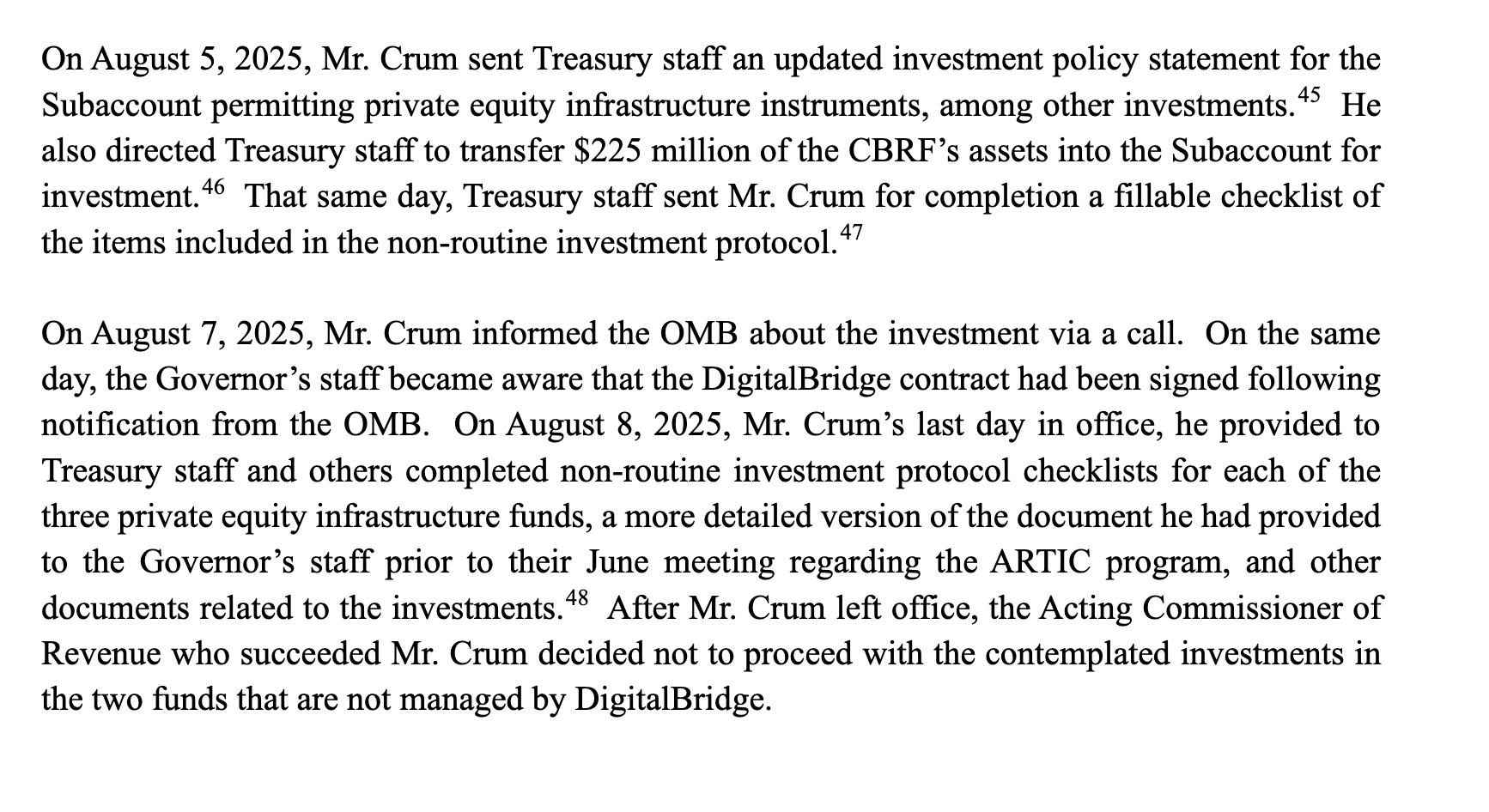

From the WilmerHale investigation of Adam Crum’s decision during his last days in office to make long-term investments with $225 million of state money that might be needed soon to pay for government operations.
Your contributions help support independent analysis and political commentary by Alaska reporter and author Dermot Cole. Thank you for reading and for your support. Either click here to use PayPal or send checks to: Dermot Cole, Box 10673, Fairbanks, AK 99710-0673.