
The Permanent Fund at 50
Fifty years ago this spring state House voted overwhelmingly to propose a constitutional amendment that would have saved all future oil taxes, plus 25 percent of oil royalties.
The House proposed putting 25 percent of all oil revenue in the fund, as described by Reps. Hugh Malone and Terry Gardiner, the leaders of the finance and judiciary committees.
But the 25 percent plan was tied to the oil tax level at the time. When the state increased oil taxes it would have added them to the savings account.
The state Senate, where many of the leading members were a decade older and had been in politics longer, did not have the same appetite for locking away future revenues created by nonrenewable resources that would always be in decline.
Viewed from one angle, the Senate’s refusal to adopt the House plan represents a lost opportunity of enormous consequence. Or it could have been a sensible compromise that improved the odds that the fund would not be a temporary blip.
On the last day of the 1976 session, the Senate approved a version of the Permanent Fund amendment that excluded oil taxes from the required contributions to the fund. Rather than risk killing the Permanent Fund entirely, the House accepted the scaled-down version to save at least 25 percent of future oil royalties.
Fifty years ago no one in Alaska had any idea that three years later a revolution in Iran would touch off events that flooded the Alaska treasury with more billions than anyone had dreamed when the pipeline began pumping oil to Valdez in 1977.
Had the House plan been in place when the oil boom arrived in 1979-1980, many more billions would have found their way into the fund. The uncontrolled expansion in state spending that was marked by excess might have been tempered. The hysteria that ended with the repeal of the state income tax might have been recognized as a terrible idea.
Things were added to the capital budget at the height of the frenzy with no real thought.
But “what might have been” theories like this also have to include the possibility that the Constitution would have been amended promptly to allow more money to be spent on current needs.
Timing was essential in the creation of the Permanent Fund. In 1976, money that had yet to appear was an abstraction, which made it easier to decide to try to live without it.
The circumstances had something in common with the Alaska Constitutional Convention in 1955-56, where the effort to create the framework for Alaska’s government was made much easier because the state did not exist. It was an academic exercise that encouraged visionary thinking.
Fairbanks Sen. Terry Miller, 33, a brilliant young man who was already an experienced legislator, worried that allowing future legislators to tie up “millions and millions and millions of dollars the state might need on an ongoing basis later” was a mistake.
He mentioned how a future Legislature and governor, acting in concert, could cripple government services by putting too much money into the principal, so that it could never be touched. The amendment was too dangerous, he said.
Miller, who died of cancer at 46, expressed what was and is a legitimate fear. We have been lucky to have never had a governor and Legislature with the ability to act in concert the way he predicted.
Miller proposed, and the Senate adopted, an amendment that Miller and others thought would ban lawmakers from adding more than 25 percent of royalties to the principal.
Fairbanks Sen. John Huber and Clam Gulch Sen. Clem Tillion claimed the amendment gutted the Permanent Fund.
Huber was the only member of the Senate who voted to include oil taxes in the savings plan. He complained that the state needed to save more, but he would still vote for the fund “if it only put two cents in the kitty for the future.”
Juneau Sen. Bill Ray said he would vote for it to see if Alaskans wanted to “take funds that are necessary now for the operation of their government and lock them away” and then be forced to borrow money to pay to keep the doors open.
While Huber said his constituents were demanding action because the state had “piddled away” the $900 million from the 1969 lease sale, Sen. Jay Kerttula said he believed that people were saying to save “it all except for us.”
The Senate vote was 18-1, with Miller the only no, even with the amendment that he thought made it impossible for the Legislature to add more money to the principal.
“It would have been a disaster to pass the resolution without the amendment which the Senate so wisely adopted a few moments ago. I’m trying as a courtesy to the administration to sit here and not tell why I’m the only red light up there. I suspect there’d be a lot more if we really called the chips. The amendment at least makes the thing workable. You would have had financial disaster in 10 years in this state if the amendment had not passed,” Miller said.
Miller’s amendment did not do what he thought. In response to the periodic spikes in oil prices, the Legislature has added many billions more to the fund than required by the Constitution.
After the Legislature approved the final text for the ballot, Kenai Rep. Hugh Malone told Daily News reporter Howard Weaver that he was disappointed that oil taxes had been eliminated from the savings rule. The fund could have been much greater, he said.
“Our resources and the wealth they represent are running out of this state,” said Malone, perhaps the leading legislative architect of the Permanent Fund. “That’s a major problem. Hey, 60 percent of the wages from the trans-Alaska pipeline are running out of the state.”
“The main concerns of this fund ought to be diversifying the economy of Alaska of developing the resources first of all for the people of Alaska. Agriculture, timber, fish businesses—we’ve got to put the emphasis on things owned and operated for the people of the state,” Malone said.
“If the resource leaves the state, the value shouldn’t,” he said.
All the expectations for the Permanent Fund were based on conditions that prevailed before the 1979 Iranian revolution when Ayatollah Khomeini became the first supreme leader. Oil prices rose by 250 percent from 1978-1980, changing every calculation about Alaska’s finances and the vision for the Permanent Fund.
That went hand-in-hand with a decision by the state to make the Permanent Fund more of a trust, favored by the state House, and to turn away from the development bank plan favored by the Senate. The state offered loans and grants through other state agencies, while the Permanent Fund was focused on investments Outside that made money.
The Permanent Fund today contains about $86 billion. It could have been more. It could have been less. With the long-term decline in oil production, the fund is now the major source of revenue to run the state government. A lot changes in 50 years.
Your contributions help support independent analysis and political commentary by Alaska reporter and author Dermot Cole. Thank you for reading and for your support. Either click here to use PayPal or send checks to: Dermot Cole, Box 10673, Fairbanks, AK 99710-0673.\
Write me at dermotmcole@gmail.com
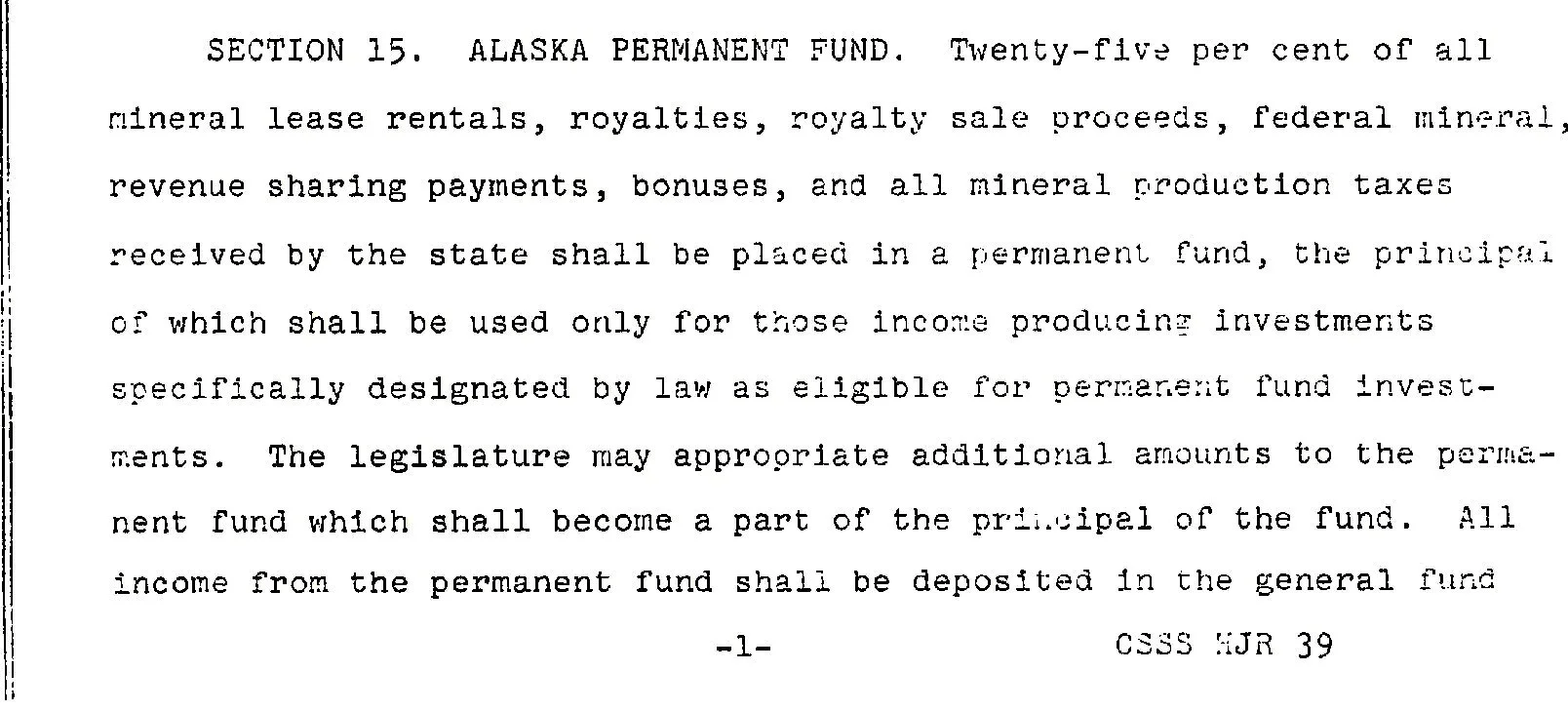
This was the version of the Permanent Fund approved by the House in 1976. The Senate rejected the portion that said “all mineral production taxes” would be saved. The final amendment said at least 25 percent of royalties had to be saved.
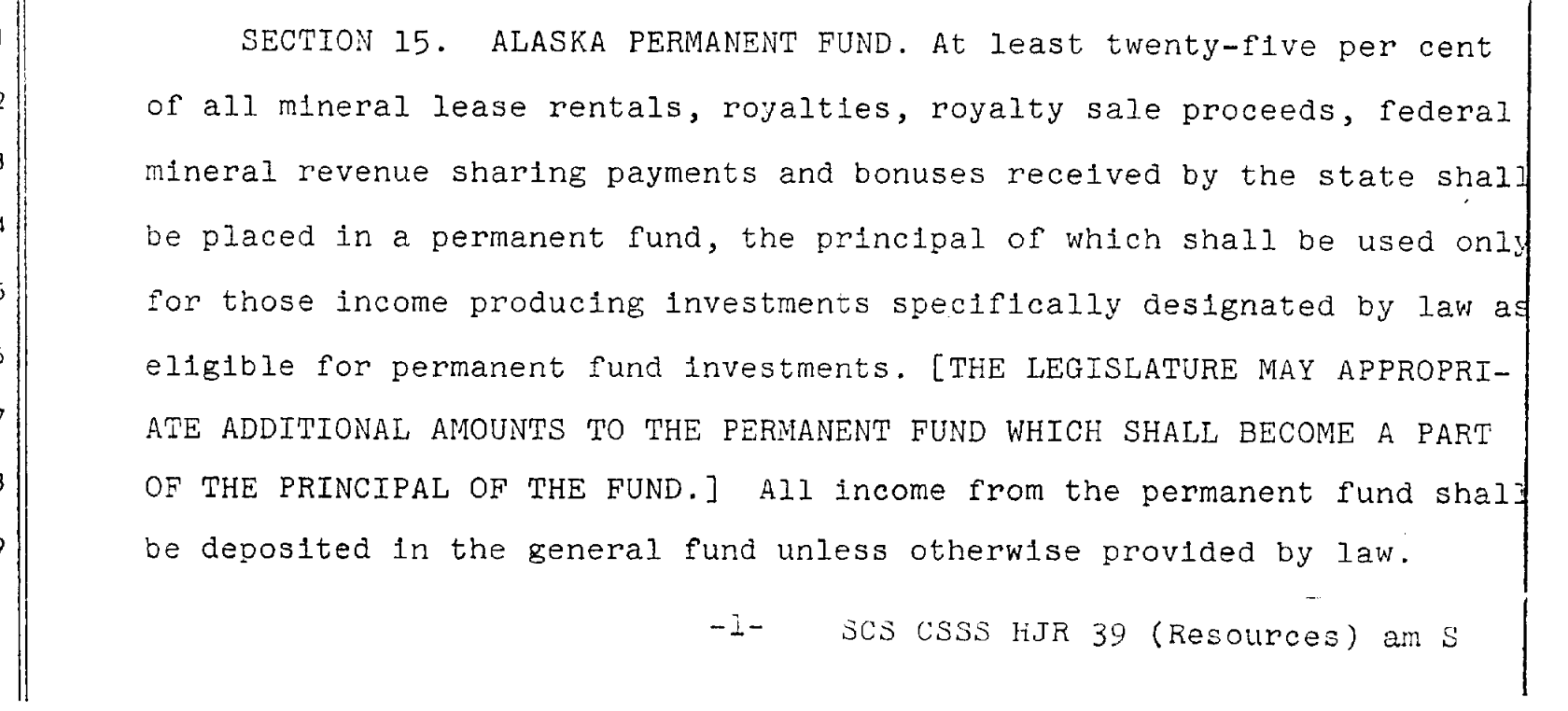
The Senate version of the Permanent Fund amendment that said at least 25 percent of royalties had to be saved for the future. Alaska voters approved this amendment in November 1976. The sentence in all caps was removed from the amendment, but it did not do what Sen. Terry Miller thought. The first two words of the amendment “at least,” made it clear that added amounts could be deposited into the fund.