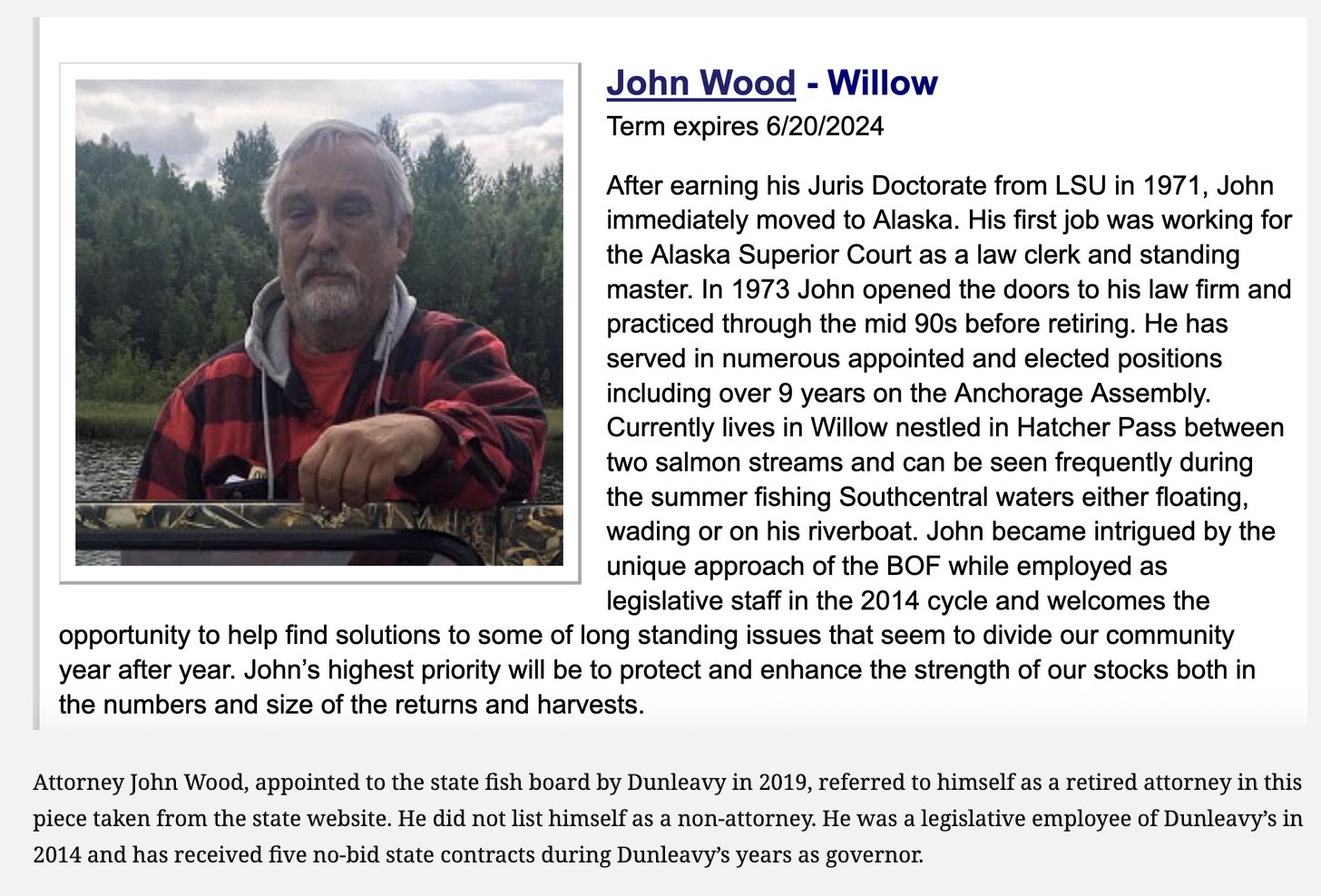
Should a man convicted of not paying his taxes be allowed to evaluate Alaska judge candidates? No.
The Alaska Legislature has a straightforward decision to make about attorney John W. Wood, 79, who doesn’t belong on the Alaska Judicial Council, one of the few state boards created in the Alaska Constitution.
It’s not just because he is a suspended attorney and he should never have been named by Gov. Mike Dunleavy for a six-year term to occupy a seat required by the Constitution to be filled by a non-attorney.
And it’s not just because he has received nearly $1 million in no-bid consulting contracts from Dunleavy, his longtime political ally. The Alaska Constitution says that appointees to the judicial council are not allowed to occupy a “position of profit” with the government. The no-bid Dunleavy contracts have been Wood’s major source of income during the Dunleavy years.
The most important issue regarding Wood’s fitness to evaluate judge candidates is his 1993 conviction in federal court for failing to file his federal taxes in 1987. He didn’t follow the law.
Wood, a former Anchorage assembly member, may be a qualified candidate to serve on many other state boards. But not this one.
Dunleavy previously appointed Wood to the fish board in 2019, a position that did not create the same ethical problems.
When Wood applied to serve on the fish board, he wrote of his tax conviction this way: “Pled to one misdemeanor of failure to file federal tax return in early 1990s which resolved long standing dispute with IRS.”
That downplays the significance of his 15-year dispute.
On November 2, 1984, the Anchorage Daily News reported that the IRS had seized Wood’s law office in a dispute over back taxes, but allowed him to reopen after agreeing on a plan to negotiate how much he had to pay.
An IRS spokeswoman said that tax liens had been filed against Wood’s home and business in 1983. The IRS seized business furniture and office equipment.
“The IRS charged Wood with not paying his personal income tax in 1977, 1979, 1980, 1981 and 1982. He also was charged with not paying employment income and Social Security withholding taxes between September 30, 1980 and December 31, 1982,” the Daily News reported on November 2, 1984.
Wood told reporters at that time that he filed tax returns, but the IRS disagreed on how much he owed. The IRS said it took the action after he had been sent four notices about the taxes he owed.
The following July, in 1985, the IRS seized his three-bedroom house in Muldoon and made plans to sell it to pay back taxes.
At the time the IRS said he owed $34,179 in personal income taxes and $48,657 in employment and Social Security taxes for the employees of his law firm.
A federal judge blocked the IRS from selling the house after Wood’s wife, Mari, filed a lawsuit saying she owned half of the house and they had separate finances. There was an attempt to negotiate a settlement.
John Wood acted as his wife’s attorney for the lawsuit.
In 1986, the federal government went to court to try to force a sale of Wood’s house to pay the back taxes, the Anchorage Daily News reported on March 2, 1986.
Six years later the IRS won a judgment of $151,080 to cover unpaid income taxes and employment taxes between 1977 and 1985, the Anchorage Daily News reported. Wood did not contest that decision.
With all of his municipal salary as an assembly member being seized in the late 1980s and early 1990s, he said he didn’t think he owed any added taxes and that he wouldn’t be charged with a crime for not filing on time.
“Wood said the government seized his $15,000 annual municipal salary between 1987 and 1990. Court records show the government also seized his permanent fund checks and office furniture,” the News reported.
On July 23, 1993, Wood entered a guilty plea about more unpaid taxes, Sheila Toomey wrote in the Anchorage Daily News.
It was part of a deal in which the government dropped charges that he did not file returns in 1988, 1989 and 1990. He was sentenced to four years probation and 150 hours of community service.
“His plea is not an acknowledgement that he owes the taxes demanded, he said. It's a decision to stop fighting even though he believes he is right,” Toomey wrote.
“An avowed libertarian, by philosophy although not by party registration, Wood is broadly anti-government and anti-taxes but does not characterize his differences with the IRS a tax protest,” the Daily News said.
"I just simply got behind the eight ball financially and it just snowballed," he told the newspaper. “He accused the IRS of ‘using the criminal system to collect a debt.’”
On Feb. 10, 1995, the Alaska Supreme Court publicly censured Wood as a result of his conviction for failure to file a 1987 tax return.
“Wood pleaded guilty to the federal charge in 1993. After Bar (Alaska Bar Association) counsel filed a petition for formal hearing and public proceedings commenced, Wood agreed to discipline by consent under Bar Rule 22(h) for engaging in conduct that adversely reflected on his fitness to practice law,” the Alaska Bar Association says in its account of the action.
This history should disqualify him from a position in which he is called upon to evaluate whether someone is fit to practice as a state judge in Alaska. Legislators should vote against his confirmation.
Not long after he was censured by the Alaska Supreme Court, he closed his law office and stopped paying his dues to the Alaska Bar Association. He has been a suspended attorney since 2000.
Your contributions help support independent analysis and political commentary by Alaska reporter and author Dermot Cole. Thank you for reading and for your support. Either click here to use PayPal or send checks to: Dermot Cole, Box 10673, Fairbanks, AK 99710-0673.\
Write me at dermotmcole@gmail.com.