Permanent Fund structure needs overhaul
At a 20-year reunion in 1976 of delegates to the Alaska Constitutional Convention, Katherine Nordale asked one of the convention's key advisers, John Bebout, what he thought of the plan to create the Alaska Permanent Fund that year.
She said she was shocked to hear the expert on state constitutions respond, "You are establishing a fourth branch of government."
She later wrote Rep. Clark Gruening, a key legislator who helped create the rules for the new fund, to warn him against allowing the enterprise to exercise too much control over the state.
"Unless it is managed very carefully and vigilant scrutiny is exercised every step of the way, the people of Alaska may reap little benefit, but millionaires may be created to the detriment of the general welfare of Alaska," she wrote Gruening.
Gruening wrote back that legislators worried about that potential as well and hoped to include provisions for oversight along with investment standards to seek the highest returns.
I’ve thought about Bebout’s words and Nordale’s advice from time to time over the years and believe that the call for careful management and vigilance is more important than ever.
I didn’t help create the fund. But along with 75,587 others I voted for the constitutional amendment in 1976 to start it. The first big project I did as a reporter was a 1977 series on creating a management structure for the fund.
I hope you will join me at an online panel discussion later this month about key issues regarding the future of the Alaska Permanent Fund, organized by Alaska Common Ground, a nonpartisan group that focuses on Alaska public policy.
Here is everything you need to know about the event, set for 6:30 p.m. to 8 p.m. March 31.
The event is to begin with an overview by veteran Alaska attorney and former Rep. Cliff Groh on the structure and governance of the fund.
The other panelists are former Senate President Rick Halford, who served in the Legislature for more than 20 years, and former Attorney General Craig Richards, a former trustee of the Permanent Fund and a longtime Alaska lawyer.
Both Halford and Richards have long experience in state government and are well versed in the history and operation of the fund, now valued at more than $87 billion.
Over the next couple of weeks I plan to write here about some structural issues with the fund that I believe need our attention as Alaskans.
One of the big ones is that the governance structure established 45 years ago was fine when the fund was of insignificant size and played an insignificant role in Alaska.
The structure is no longer adequate for the most important financial institution in Alaska. The fund is not the fourth branch of government, but it is as important to our survival as the courts, Legislature and executive.
One of our biggest problems is that there is too much power over the Permanent Fund bestowed on a single person in the executive branch of state government—the governor.
The governor chooses the six trustees who oversee the Alaska Permanent Fund Corporation. The trustees have the power to hire and fire the chief executive officer of the corporation.
There is no legislative confirmation, no formal vetting process for applicants and no checks and balances. The law says that trustees can be fired only for cause and in writing, but it does not say what constitutes a “cause.”
The law also says that people chosen to be trustees must “have recognized competence and wide experience in finance, investments, or other business management-related fields.” This is vague language that allows anyone from the manager of a hot dog stand to a bank president to qualify as a trustee responsible for billion-dollar decisions.
The rules say that two trustees also have full-time jobs as state commissioners, which means they have little time to devote to the Alaska Permanent Fund.
The revenue commissioner is required to be a trustee under the law, which may be OK during times when the governor has an exceptional revenue commissioner.
The law also requires that a second commissioner serve as a trustee. That role now is filled by DOT Commissioner Ryan Anderson. Running the transportation department should leave him no time to oversee the permanent fund.
The public members are Jason Brune, head of environmental management for the North Slope Borough; Ethan Schutt, counsel for the Bristol Bay Native Corporation; John Binkley, a former legislator and longtime Fairbanks business leader; and Ralph Samuels, a former legislator and vice president for Holland America in Anchorage.
The public trustees are paid $400 per day for each meeting they attend. This is the pay rate established in 1982 that has never changed. The public members who serve as trustees are essentially volunteers.
Even at the start, one of the key Alaska business leaders who helped get the Alaska Permanent Fund Corporation going—banker Elmer Rasmuson—believed that the system required revisions that were never implemented.
I’ll have more on that next.
Your contributions help support independent analysis and political commentary by Alaska reporter and author Dermot Cole. Thank you for reading and for your support. Either click here to use PayPal or send checks to: Dermot Cole, Box 10673, Fairbanks, AK 99710-0673.
For Write me at dermotmcole@gmail.com
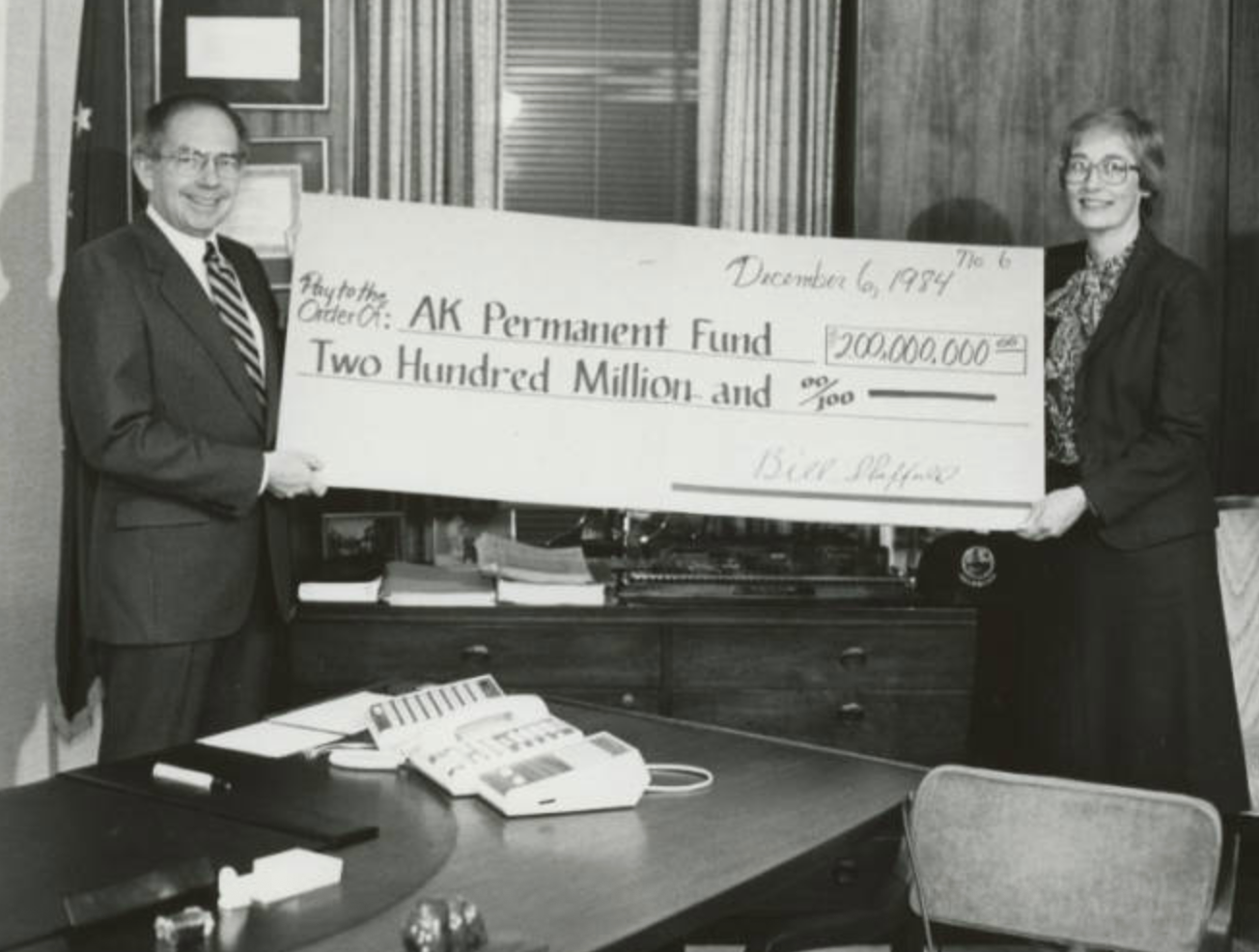
Gov. Bill Sheffield and a ceremonial check about a 1984 deposit into the Permanent Fund. At right is the late Mary Nordale, who served as revenue commissioner under Sheffield. Mary, a prominent Alaska attorney, was the daughter of Katherine Nordale, the delegate to the Alaska Constitutional Convention quoted above. Incidentally, Mary Nordale thought the Permanent Fund Dividend was a bad idea and never applied for one.