Dahlstrom invited feds to intrude on state elections
Lt. Gov. Nancy Dahlstrom, a Republican candidate for governor, signed off on the state decision to cede control of a key state function to the Trump administration.
Former Sen. Tom Begich, a Democratic candidate for governor, sized up what Dahlstrom did and what needs to happen next:
“I'm outraged that Lt. Gov. Nancy Dahlstrom handed our full voter file to Trump under a confidential agreement that gives the DOJ power to review our rolls and pressure the state to remove voters within 45 days of notice. That kind of federal interference threatens our constitutional right to run our own elections. These decisions belong to Alaskans, not politicians in D.C. The Legislature needs to investigate this immediately,” Begich wrote on X/Twitter.
It appears that Dahlstrom did not carefully read the agreement she approved or she doesn’t understand what she approved, accusing Begich of “fear mongering.”
“Alaska maintains full control of our elections and our voter rolls. No federal agency has the authority to remove a single Alaska voter. Period. Cooperation with federal authorities to ensure our voter rolls are accurate and lawful is not “federal interference.” It’s responsible governance and protecting election integrity,” Dahlstrom wrote on X/Twitter.
What Dahlstrom did was not responsible governance. It has nothing to do with election integrity. Period.
Anyone who reads the memo Dahlstrom approved with the Department of Justice can see that she agreed to give confidential personal data on all Alaska voters—going far beyond the information that is available to the public—and is asking the Department of Justice to instruct the state on who should be removed from the voter rolls.
A section of the memo approved by Dahlstrom says the state “will clean” its records by “removing ineligible voters” as determined by the Department of Justice.
She agreed to do this within 45 days of getting a list from the Trump administration.
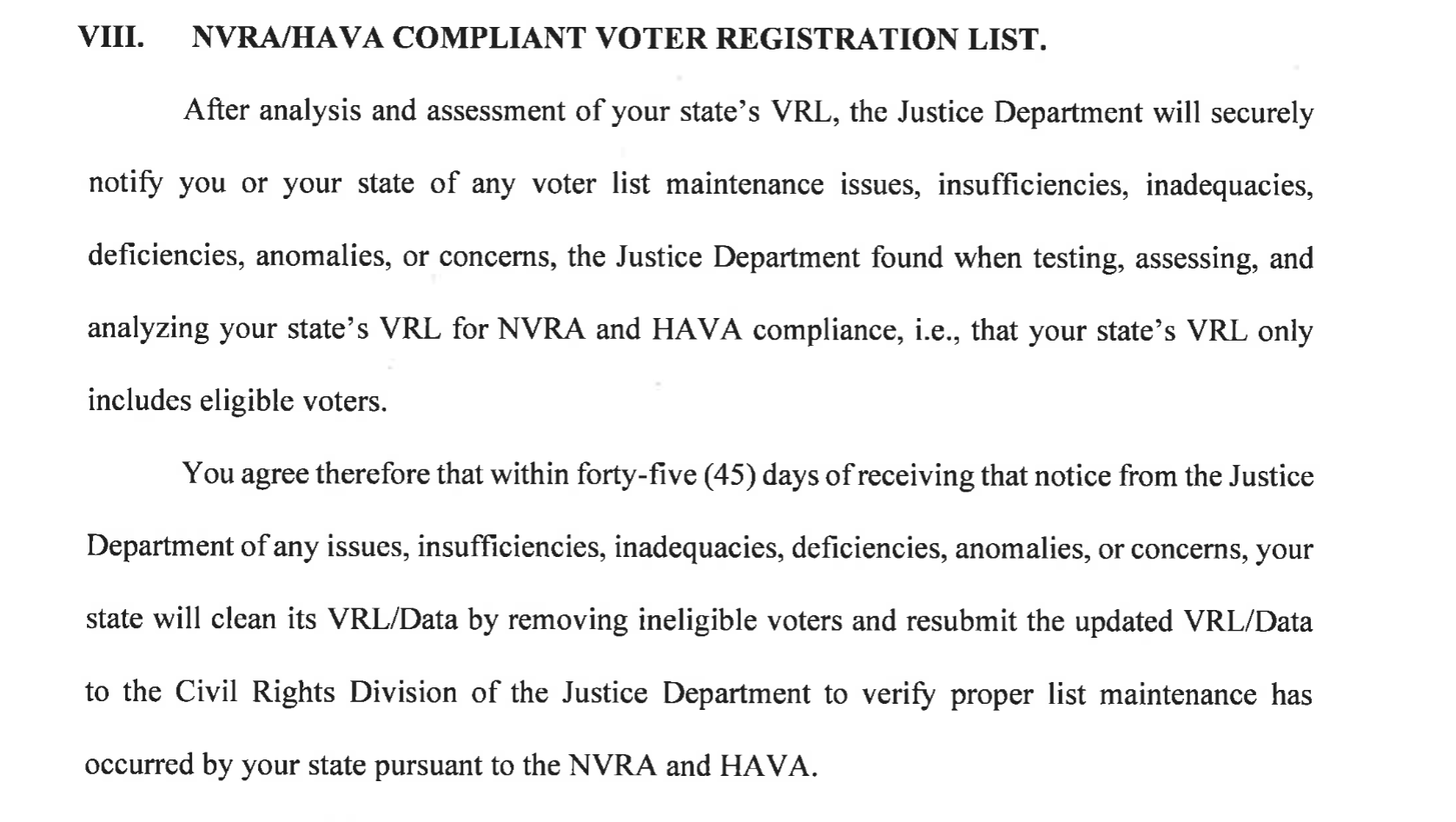


A memo approved by Lt. Gov. Nancy Dahlstrom allows the U.S. Department of Justice to review the list of voters in Alaska and includes a pledge that the state will remove ineligible voters and send the list back to the federal government for review. This is a state function, not a federal function.
In an extended song-and-dance to the Alaska Beacon, Carol Beecher, the head of state elections and Kelly Howell, chief of staff to Dahlstrom, claimed the memo doesn’t mean what it says it means about removing names from the voter lists and where the idea for doing this came from.
The agreement was not entered into at the request of the state, Dahlstrom said in an accompanying December 19 letter, but at the request of the Department of Justice.
Dahlstrom should have read the part of the memo that says the memo was proposed, made and entered into at the request of the state of Alaska.
In fact, it’s Trump’s repeated lies about the election process that prompted this 50-state effort to nationalize elections. Dahlstrom should have just said no.
To claim, as Dahlstrom does, that the memo does not give the Department of Justice the power to tell the state what names it wants removed from the list is to deny the plain meaning of the text.
The Department of Justice says it will identify voters that are ineligible and that the state has agreed to act on its recommendations when the department finishes its review.
“You agree that within forty-five (45) days of receiving that notice from the Justice Department of any issues, insufficiencies, inadequacies, deficiencies, anomalies, or concerns, your state will clean its VRL/Data (Voter Registration List) by removing ineligible voters and resubmit the updated VRL/Data to the Civil Rights Division of the Justice Department to verify proper list maintenance has occurred by your state,” the memo says about the state’s role.
The attorney general’s office allegedly did a “thorough” review of the legal issues, but former Attorney General Bruce Botelho has a far better grasp on this matter than temporary AG Stephen Cox.
“It is alarming that the federal government has demanded such records. The National Voter Registration Act, which was passed in 1993 and expands voters’ rights, does not entitle the federal government to collect data on voters or to do voter list maintenance for the states. Only the states have the authority to do that,” Botelho wrote in a column for the Juneau Independent.
“The right to privacy was not added to our constitution as decoration; it was written to guarantee that government would be accountable to the people, not the other way around. By yielding voter information without transparent purpose, enforceable limits, or serious public debate, the lieutenant governor has lost sight of that promise. Alaska should immediately revisit this decision, assert its constitutional prerogatives, and join those states — like California and Oregon — that have already drawn a clear line between voter registration and federal overreach. Protecting the privacy of Alaskan voters is not defiance. It is the state doing exactly what our constitution demands.”
Your contributions help support independent analysis and political commentary by Alaska reporter and author Dermot Cole. Thank you for reading and for your support. Either click here to use PayPal or send checks to: Dermot Cole, Box 10673, Fairbanks, AK 99710-0673.
Write me at dermotmcole@gmail.com.