Sullivan claimed he would accept election results. Will he?
The first Alaska Republican to lose a U.S. Senate race in Alaska for 20 years is going to have to face the inevitable.
Mary Peltola has won the election, but Sen. Dan Sullivan has yet to make good on his pre-election promise to accept the results, win or lose.
Gov. Mike Dunleavy, still competing for Trump’s favor, keeps floating the possibility that Sullivan might want to challenge the results in court, though Dunleavy has failed to explain what grounds Sullivan might try.
The Alaska Department of Law says the Trump suit has no merit.
Sullivan has contradicted himself more than a few times in this mess. In a bit of pre-election gibberish on CNN, he claimed that if he didn’t get enough votes the election would have been “stolen” from him.
Asked by Jake Tapper if he would ‘only going to accept the election results if you win,” Sullivan said: ‘No, I’m going to accept the election results.”
But he added this bit of nonsense, ‘To all Alaskans watching, get out there and vote. Don’t let this election be stolen.”
The election was not stolen. Peltola received votes than Sullivan and will replace him in the U.S. Senate. Sullivan lost.
And the votes for Petersburg Dan Sullivan did not cost Ohio Dan the election.
In July, Sullivan claimed that his campaign would make sure that Alaska voters knew which Sullivan was which on the ballot, so that voters would not be confused.
After Trump took up Sullivan’s cause, the incumbent senator began claiming that thousands of voters would probably vote for the wrong man.
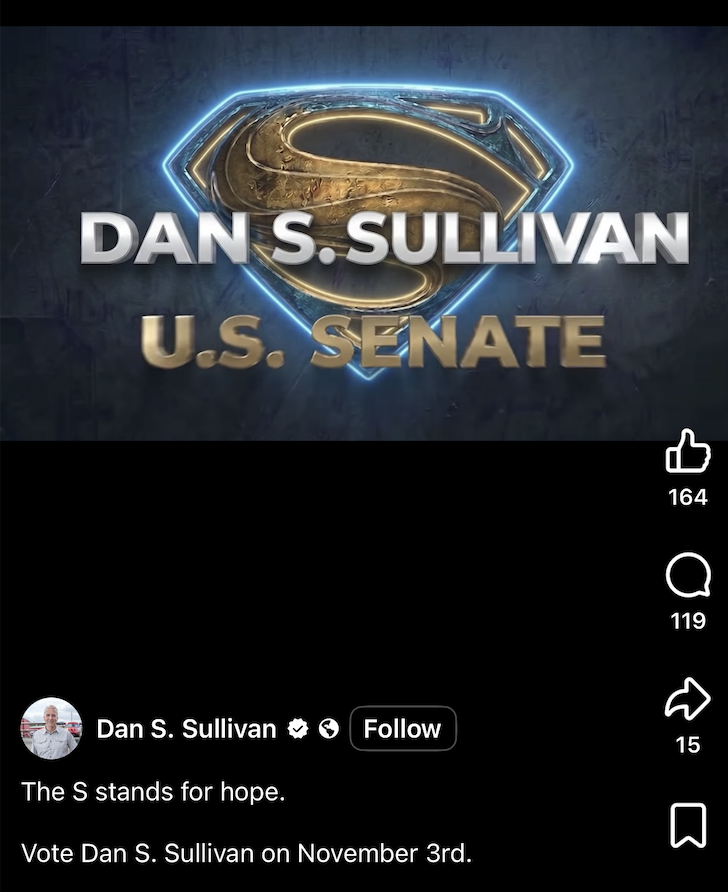
This, even though Sullivan had taken to pitching himself as Dan S. Sullivan with a Superman logo, claiming for some reason that the middle initial “S” stands for Hope. That would only work for someone named Dan H. Sullivan or for an election on Krypton.
President Donald Trump, meanwhile, continues his effort to tamper with the election results in Alaska, asking the 9th U.S. Circuit Court of Appeals to illegally intervene in the Alaska election.
Peltola leads Sullivan by more than 10,000 votes and her victory is likely to be official by Wednesday. Even if every vote of the other Dan Sullivan went to the incumbent, Peltola would win.
The Trump lawsuit, which Sullivan has refused to denounce as federal overreach, is a clear infringement of state’s rights. It turns out that Sullivan likes federal overreach when it suits him.
Federal Judge Sharon Gleason dismissed the Trump attempt to interfere with the U.S. Senate election in Alaska.
Sullivan has claimed to have no opinion that he is able to share with Alaska voters. He did have a campaign employee say, “We’ll let the DOJ complaint run its course.”
The Trump administration waited until the last minute to file its lawsuit, seeking to stop certification of the election, but only if Trump’s favored candidate did not win.
The months of federal delay and the illegal encroachment on state’s rights are the main reasons why the Trump appeal should be rejected, UCLA Law Professor Richard Hasen wrote in this proposed amicus brief.
The U.S. Constitution is clear that states control elections.
“The district court in its initial order laid out the many months of administrative procedures and litigation that took place in Alaska over whether and how Dan J. Sullivan should appear on the ballot given claims about potential voter confusion with another candidate, the incumbent Senator Dan S. Sullivan,” he said.
Trump and Sullivan have claimed that many Alaskans were too stupid to read the ballot and vote for the preferred Sullivan.
“Undeterred by the plain text of the Constitution, 250 years of history of state and local administration of federal elections, and the House and Senate holding the power to resolve election disputes for each respective chamber, the United States purports to find federal executive branch authority over Alaska’s process of certifying the winners of elections in the preamble of a 1993 law, the National Voter Registration Act, which governs rules related to voter registration in federal elections,” Hasen wrote.
“The federal government asserts especially broad powers, seeking to block certification but providing no details as to how and when Alaska’s certification process could be altered upon a finding (by whom?) of some amount (how much?) of voter confusion.”
“If Congress intended to give the federal government these breathtaking powers over states—contrary to American history and tradition—it would not hide such an intent in the preamble of a statute about voter registration.”