State blasts Trump's unconstitutional effort to block Peltola from U.S. Senate
Gleason agreed with Senate candidate Mary Peltola and others that the case deserves expedited treatment—she ordered the Trump administration to file a response by Tuesday at 5 p.m.
She also said that the State of Alaska, which had yet to intervene in the case, would also have until 5 p.m. Tuesday to respond.
The state Department of Law acted Monday, agreeing that Gleason should dismiss the case because what Trump told his attorney general to do is unconstitutional.
And voters will not be confused by the Sullivan saga, despite what Trump and Attorney General Todd Blanche claim.
This was the right decision by the Dunleavy administration, one that is likely to trigger Trump and his henchmen, as well as Sullivan.
I was happy to see that some of the top professionals in the Alaska attorney general’s office were allowed to deal with this issue in the honest and forceful manner it deserved, devoid of partisan politics. Carol Beecher, the elections director, also deserves credit for standing up to defend Alaska’s election.
Here is the state’s motion. It is an excellent piece of work, a document that exposes the Trump complaint as garbage. It directly contradicts many of the lies spread by Trump and Blanche about the Alaska election.
Writing for the state, attorneys Margaret Paton Walsh and Laura Fox said the federal government “lacks authority to intervene in state elections at all, much less in support of a favored candidate. This Court should follow the well-established principle that “lower federal courts should not ‘alter the election rules’ of a state ‘on the eve of an election,’ and swiftly dismiss the complaint.”
More on this first-rate legal document from the state later.
Gleason will dismiss the case because the federal claims, founded not on the law but on political desperation by Trump and a feckless U.S. attorney general, have all the merit of talk-show blather.
Trump will keep trying to illegally boost Sullivan and set the stage for claiming that if Sullivan loses, it will be because the Democrats cheated. The state’s court filing will make it harder to say that with a straight face, but Trump never speaks with a straight face.
Gleason wrote in her order that the federal government waited nearly four months to act and early voting is already taking place.
Trump’s unprecedented attack on Alaska’s U.S. Senate race to aid Sullivan is the most extreme example of federal overreach in Alaska’s short history.
The incumbent senator, who has made a career out of finding federal overreach at least once a week, has gone deaf, dumb and blind in this obvious instance.
Sullivan has refused to talk about Trump’s tampering plans, which amounts to Sullivan’s tacit support for election interference.
By contrast, Sen. Lisa Murkowski was correct in saying the Trump lawsuit is completely out of line.
Sullivan is taking cover behind Trump and Attorney General Blanche, who stepped up the Alaska attack Sunday and lied at length on national television.
Trump claims his lawsuit is to stop an “impending crime and tragedy,”—the crime and tragedy being the defeat of Sullivan.
What the’s crime? Dana Bash of CNN asked Blanche.
The AG, whose tenure under Trump has been marked by trying to keep the Epstein files secret, could not identify a crime in the Alaska case.
“Well it’s not only the president that’s saying that,” said Blanche. “It’s the director of the Alaskan election process.”
The Alaska Supreme Court said four months ago the election director was wrong, but Blanche is pretending that never happened. And as of Monday, the elections director is denying Blanche’s claim that there is a problem.
This is election tampering by Trump and Blanche to try to save Sullivan and preserve enough Republicans in the Senate to protect Trump’s backside.
Nothing in the Trump lawsuit rises above the level of Trump prattle about Alaskans being too dumb to know the meaning of the word incumbent.
We can only hope that Trump’s lawless attack will be dismissed Wednesday. Trump will appeal, but no matter.
The lawyers for Mary Peltola and the Democratic Party are not being extreme when they described the danger in an emergency motion filed Sunday.
“If this lawsuit remains pending when results from Alaska’s Senate race begin to be released next Tuesday, November 3, and if those results suggest a narrow victory for Mary Peltola, Alaskans for Mary and DSCC are seriously concerned that the Attorney General and the President will use the pending lawsuit to falsely suggest that there is doubt about the lawfulness of Alaska’s election results, without any legal basis, to lay the groundwork for unlawful efforts to challenge a potential Peltola victory,” said attorney David Fox in a court filing asking for immediate dismissal.
“To prevent further damage to public trust in Alaska’s elections from this meritless lawsuit, Alaskans for Mary and DSCC ask the Court to expedite consideration of their Motion to Intervene and of their proposed Motion to Dismiss, and to dismiss the case this week, before election day.”
Their motion says the court should not allow the lawsuit to hang like the Sword or Damocles over the election, “lending false legitimacy to the President’s and the Attorney General’s ongoing efforts to spread false narratives about Alaska’s elections as voting continues and as results begin to be tabulated next week.”
Here is their motion for emergency review, asking for a schedule that would allow the lawsuit to be dismissed this week.
Here is a motion filed Monday by the League of Women Voters and others seeking to intervene, also calling for immediate action.
The federal government would have to reply by Tuesday at 5 p.m. We’ll see if E. Bryan Wilson, an assistant U.S. attorney in Anchorage, continues to sign his name to this laughable lawsuit aimed at undermining the right of Alaskans for a fair election.
Todd Blanche embarrasses office of AG
Blanche, a Trump hack who is only attorney general because Sullivan cast a deciding vote for him, was on Face the Nation Sunday, lying about every aspect of this situation, including about whether there are two Dan Sullivans.
If you want to hear the entire sorry performance, click here.
Blanche lied about the lawsuit he filed. He lied about the Alaska Supreme Court. He lied about the ballot and he lied about federal law.
He appears to be a man who can’t handle the truth.
Blanche emitted a series of farcical statements about the Alaska lawsuit, even saying he couldn’t confirm that Trump ordered the lawsuit, a statement Trump made on camera.
After Face the Nation journalist Margaret Brennan accurately summarized the situation of two Dan Sullivans, Blanche claimed she was lying.
“You described facts that were just simply either at best misleading, but were really a lie to your viewers. It is not two Dan Sullivans, one an incumbent and one running. That's not true,” Blanche said to Brennan.
“The head of the Alaska Election Commission, not – not President Trump, not me, has said that the second Dan Sullivan is running solely to confuse voters, solely to pull votes away from the incumbent senator. OK, so that is something that we're dealing with. It's not just two Dan Sullivans running on the ballot in Alaska. That is not true.
“And, second, President Trump has been talking about what a travesty this is for many, many, many months, and the Department of Justice has been looking at it for many, many, many months, as we should under federal law. And you saw what we did earlier this week, late last week.
“And it was not – it's not to let the federal government take over the Alaska system of selecting their next senator or certifying who's going to be senator. It's asking the court to step in where the Alaska Supreme Court didn't, which is to look at federal law, and, if necessary, to allow a process for Alaska to decide who should be —who should be certified as a winner.”
Brennan replied, correctly, that the Alaska Supreme Court upheld a lower court ruling that "The assertion that Mr. Sullivan seeks to confuse or misguide voters is not supported by preponderance of evidence."
She showed a picture of the ballot, which makes it clear which Sullivan is which.
Blanche chimed in to claim that the Alaska Supreme Court did not rule on what he claims is federal law about voting.
This exchange followed:
BLANCHE: No, they didn't. They didn't. That's the state law. That's the state law.
BRENNAN: Just to make clear here…
BLANCHE: That's the state law.
BRENNAN: This is how the state – in this country, the states administer the elections. This is how the state came up with the issue and how to handle any confusion. Our viewers are seeing it right now. It's ranked-choice voting.
BLANCHE: I mean, you're not – you're not telling the truth. You're not being honest with the voters.
BRENNAN: They can see that Dan – I'm showing the ballot to the viewers right now.
BLANCHE: You're not.
BRENNAN: It's on the screen. It says Dan S. Sullivan is listed as the incumbent. Why is that – it says incumbent. Why is that not sufficient?
BLANCHE: Well, listen. I don't know if it's sufficient, but I can tell you this, that the director of the Alaska election system has said that it will likely cause confusion.
And so you – you can continue to talk and continue to state facts as you want them to be, but that's different than the way that they actually are. The Alaska Supreme Court did not rule on the federal law that's implicated in every election, and it is true that it is not often that we have to get involved.
But just take a step back. Take a step back and understand what's happening here. There is no dispute that the only reason the second Dan Sullivan is running is to pull votes away in a confusing and inappropriate manner from the Dan Sullivan incumbent, OK?
And the Alaska Supreme Court, when they issued a ruling, they didn't issue a decision yet. We're waiting for that decision to be – to – the opinion to be issued. But, in the meantime, all that we are trying to do as the Department of Justice is make sure that federal law is enforced and upheld if it needs to happen after the election.
BRENNAN: Well, the ballots are out. There's a lot of mail-in ballot voting in Alaska. The ballot's going to look like what we just showed our viewers. They are both on there.
In terms of the question I asked you, I asked if it was President Trump who told you to take this action. When the president said, "I'm the one that said do it," who did he tell to do it?
BLANCHE: So, I don't – I will never, ever, ever talk about communications that I have with the president of the United States. I never have, and I never will.
BRENNAN: No, the president of the United States actually said this on camera.
BLANCHE: But make sure that you understand that this was not the…
BRENNAN: He said: "I told them to do it." Did he tell that to you?
BLANCHE: No, that wasn't your question. No. No, he didn't say it on camera.
BRENNAN: Yes, he did.
BLANCHE: He said he told them to do that.
I said I will not talk ever about – no, that wasn't your question, I said. I said – what your question was to me is, did he tell me? And I said to you, I will not talk about communications I have with the president of the United States. I haven't ever, and I won't ever.
But I will tell you this. This is the Department of Justice doing our own research under the law, the Civil Rights Unit in the Department of Justice drafting this lawsuit, and then ultimately we filed the lawsuit. President Trump has been talking about this for months and months and months and months.
BRENNAN: Yes.
BLANCHE: This isn't something new that just came up last week. This is something that's been going on for a long time.
BRENNAN: Why did he file it 11 days before the election?
BLANCHE: Well, we were hopeful that – that the Supreme Court would actually issue an opinion and explain their reasoning. What we knew from their ruling is that they didn't consider federal law. And I'm not judging them for that. It's just a fact.
They didn't consider federal law. So we want a procedure in place that if there is litigation – there may not be, but if there is litigation brought by others after the election because of possible voter confusion, that the ballots are kept in a way that the Alaska state – that the Alaska state election system can determine who the accurate winner is, not the federal government, not President Trump, not me, but the Alaska system, as the law is required – as the law is set out for it to do.
BRENNAN: So the DOJ lawsuit says the defendants, who are the state election board and the ballot-counting review board – quote – "not certify any election result that may be impacted by voter confusion."
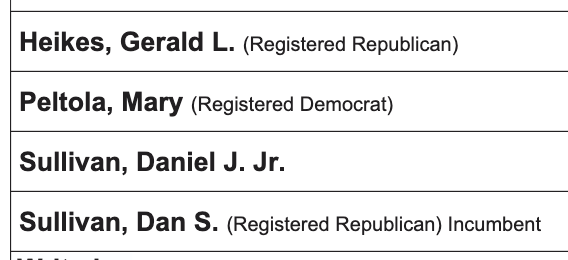
The Sullivan ballot listing is not confusing.
The confusion is defined as Senator Sullivan not winning, and had all votes cast for Daniel J. Sullivan been cast as said for Senator Sullivan, then he would have won.
How do you…
BLANCHE: That's not what it says, OK?
BRENNAN: I'm quoting from it.
BLANCHE: What it says is, the way – the way that you can determine…
BRENNAN: You are telling them not to certify it.
BLANCHE: No, no, but you – you – the way you started that…
BRENNAN: What right does the federal government have…
BLANCHE: No, no, we're not saying – we're saying…
BRENNAN: … telling a state not to certify or how to certify?
BLANCHE: We are not – we are – you know, if you talk the whole time, you're not going to get answers out of me. But if you let me answer your question, I can address your question, OK?
So the – exactly what we want is that there are ways – because of the way that Alaska ballots are set up, where – where voters can vote for more than one candidate, there is a way, potentially – we don't know what's going to happen yet – where it will be obvious from the results and from the ballots that voters were confused.
And that could be obvious from the way that they rank the Dan Sullivans or not including a Dan Sullivan on the ballot. I don't know yet because there hasn't been an election. But all we are doing is trying to put guardrails in place so that if that – this – that happens, there's a system allowed where the ballots are kept in a way so that we can determine whether there was confusion.
It's not saying, don't certify. It's saying, if a court ultimately determines that it was decided because of confusion and not the will of the voters, then we do not think the states should certify, and that's consistent with federal law and consistent with even Alaskan law, if that happens.
BRENNAN: You've been clear in saying you won't talk about your conversations with the president. Who was he referring to when he said, "I'm the one that said do it"?
BLANCHE: I have no idea who he was referring to. And even if I did have an idea, I would most certainly not talk about it.
He's not – what – what the president is saying, and what he clearly has said for the past four months, five months, is that this is a travesty, and this – in this country we should not have a system of elections where it's OK for somebody who is only running with the same name to pull votes away.
BRENNAN: Yes.
BLANCHE: And, by the way, how about we talk about that? I mean, do you disagree with that? Do you think that that's OK? You think that should be allowed in – in our system of government, someone that the – the head of the Alaskan system of voters has said that there is no scenario under which she can certify that voters will not be confused, and she lists a number of reasons why.
BRENNAN: Right.
BLANCHE: That wasn't President Trump and that wasn't me. And the fact that the conversation is about this lawsuit we filed, and not the fact that there's a person running for Senate in the United States in Alaska…
BRENNAN: Yes.
BLANCHE: … that – that the head of the elections has said is – is only running to confuse voters, that should be the conversation. And it's not. And that's – that's unfortunate. But we're going to make it . . . the conversation.
BRENNAN: Well, the Supreme Court also talked about the fact that the good faith requirement does not appear in the Constitution. So whether it was intended to be confusing or not, they sort of put that aside. Anyway, let me…
BLANCHE: Right. Correct. And so – and that's – that – no, you're totally – you're totally right about that. But that's where they did not consider federal law. You're – you're right that what the Alaska Supreme Court said is even if it's bad faith…
BRENNAN: Yes.
BLANCHE: … our laws in Alaska, for reasons that, you know, that – not up to them, don't – don't address that. But that's different than federal law, which is why we brought a federal lawsuit.”
Your contributions help support independent analysis and political commentary by Alaska reporter and author Dermot Cole. Thank you for reading and for your support. Either click here to use PayPal or send checks to: Dermot Cole, Box 10673, Fairbanks, AK 99710-0673.
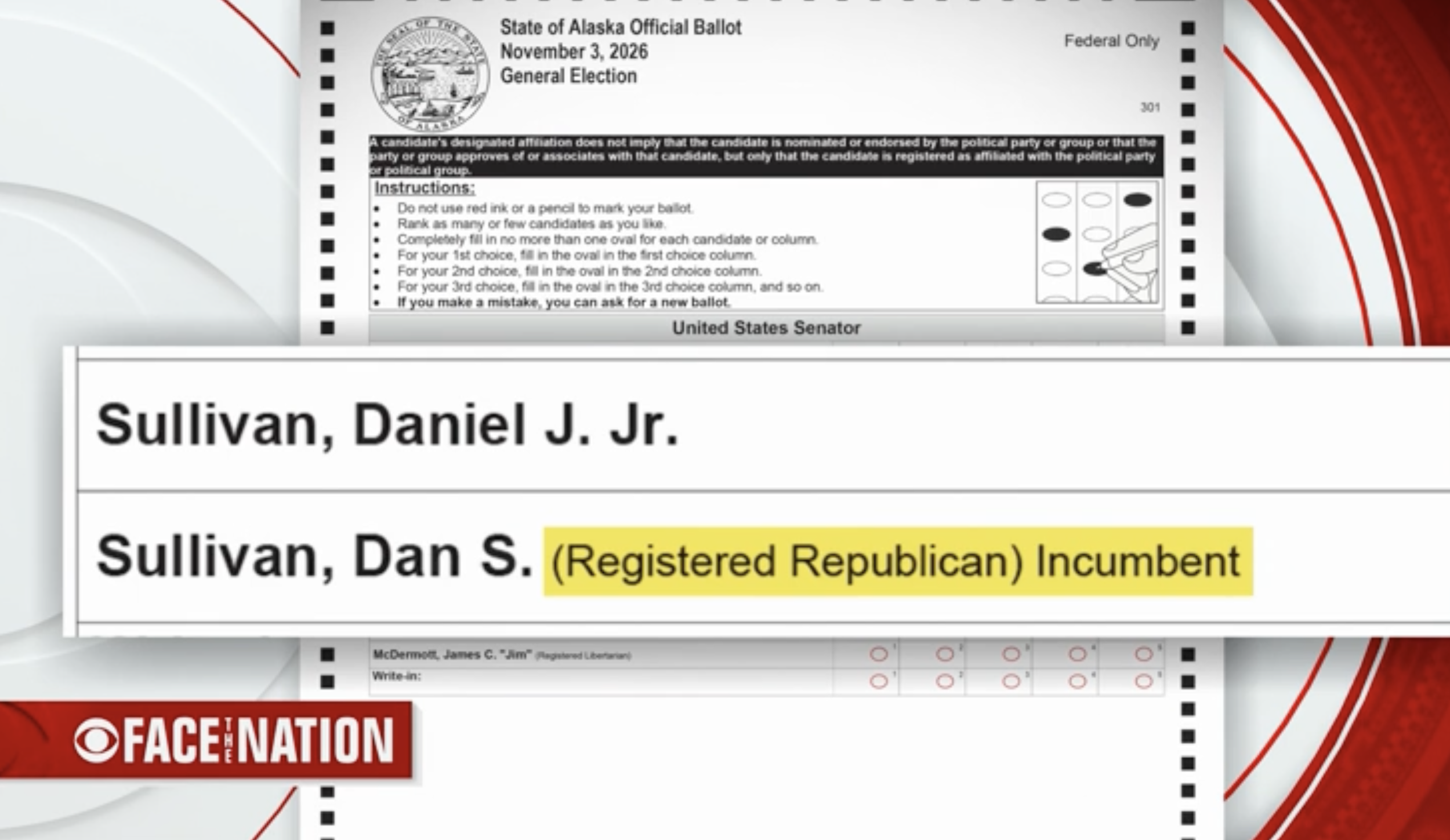
This is the image shown to viewers of Face the Nation about the Sullivans on the Alaska ballot.