Trump and his oil delusions
The claims that Trump’s desire to force U.S. oil companies to invest $100 billion in Venezuela will pay off in lower oil prices for the United States are absurd.
“Yet expert after expert told me that rebooting the country’s oil industry would require a herculean effort. It would involve training an army of workers with no experience in the industry, rebuilding decrepit processing facilities and miles of crumbling pipelines, and amassing a private security force to protect these investments from cartels and private militias. ‘I really can’t overstate just how hard this would be to actually pull off,’ Ben Nussdorf, who served as a senior adviser for the Department of Energy’s Office of Oil and Natural Gas from 2014 to 2021, told me. ‘Don’t even think about making a dollar for at least a decade.’ According to the most optimistic projections, simply restoring Venezuela’s production to its previous peak would require a decade and $100 billion of investment; more conservative estimates put the numbers closer to 15 years and $200 billion,” Rogé Karma wrote Saturday.
“In a Truth Social post before the White House meeting yesterday, Trump announced, ‘At least 100 Billion Dollars will be invested by BIG OIL.’ That prediction would be more believable if oil companies could expect a lucrative return on these gargantuan investments. But in inflation-adjusted terms, current oil prices—about $60 a barrel—are historically low. And they are well below the roughly $80-a-barrel cost of extracting and refining Venezuelan oil—much of which is the kind of thick, low-quality petroleum (known within the industry as “heavy sour crude”) that requires extensive processing.”
“Although some oil executives who met with Trump at the White House yesterday expressed a vague interest in doing business in Venezuela, ExxonMobil CEO Darren Woods offered a blunt warning about the country. ‘Today,’ he said, ‘it’s uninvestable,’” Karma said.
ExxonMobil is telling the truth.
The oil executives who expressed a “vague interest” in Venezuela included Jeff Hildebrand, owner of Hilcorp, and Bill Armstrong, owner of Armstrong Oil and Gas. They said they would put money into Venezuela, but not how much or when.
The vague Hildebrand and Armstrong didn’t get rich by being stupid.
Unlike executives from publicly traded companies like ExxonMobil, who can get into trouble with the SEC for dispensing misleading information, the owners of private companies are free to say anything they want.
Alaska lobbyist Ashley Reed, who has many clients who pay him a great deal of money to influence the state government on their behalf, gets $5,000 a month from Armstrong to claim that Alaska taxes are too high.
“If Hildebrand takes his money down there, and Bill, we don't have much left, except ConocoPhillips,” Reed said.
Such scare tactics have often worked in the past.
“In his own correspondence with Armstrong this week, Reed added, the oil executive said some of the arguments against investing in Venezuela could also be made about Alaska,” Herz wrote.
“Enormous, resource-rich areas. Erratic fiscal policy. Government seemingly unwilling to initiate meaningful reforms,” Reed said. “How is that different from Maduro's policies — where he wants it, and he just takes it?”
The oil industry and its lobbyists constantly repeat these lies about Alaska, but that doesn’t make them true. That Armstrong and Reed are out there telling people that Alaska has anything in common with the murderous tyrant Maduro is offensive. That country has the worst oil tax system in the world and a corrupt government.
What’s also offensive is that Armstrong, Hildebrand and the rest of the oil industry spent $25 million in Alaska in 2020 lying to Alaskans that they had a plan to “save jobs and the PFD.”
The oil industry said that oil taxes should be looked at in the open by the Legislature and not decided by an initiative.
There was no plan to push the Legislature to look at oil taxes in the open or to “save jobs and the PFD,” but endless repetition and money is the foundation of propaganda.
“This ballot measure goes too far. It is bad for jobs and puts our economy at risk. There has to be a better way for Alaska,” the oil companies said through their front group.
I’m still waiting to hear from Hildebrand and Armstrong about their plans to save jobs and the PFD.
Your contributions help support independent analysis and political commentary by Alaska reporter and author Dermot Cole. Thank you for reading and for your support. Either click here to use PayPal or send checks to: Dermot Cole, Box 10673, Fairbanks, AK 99710-0673.
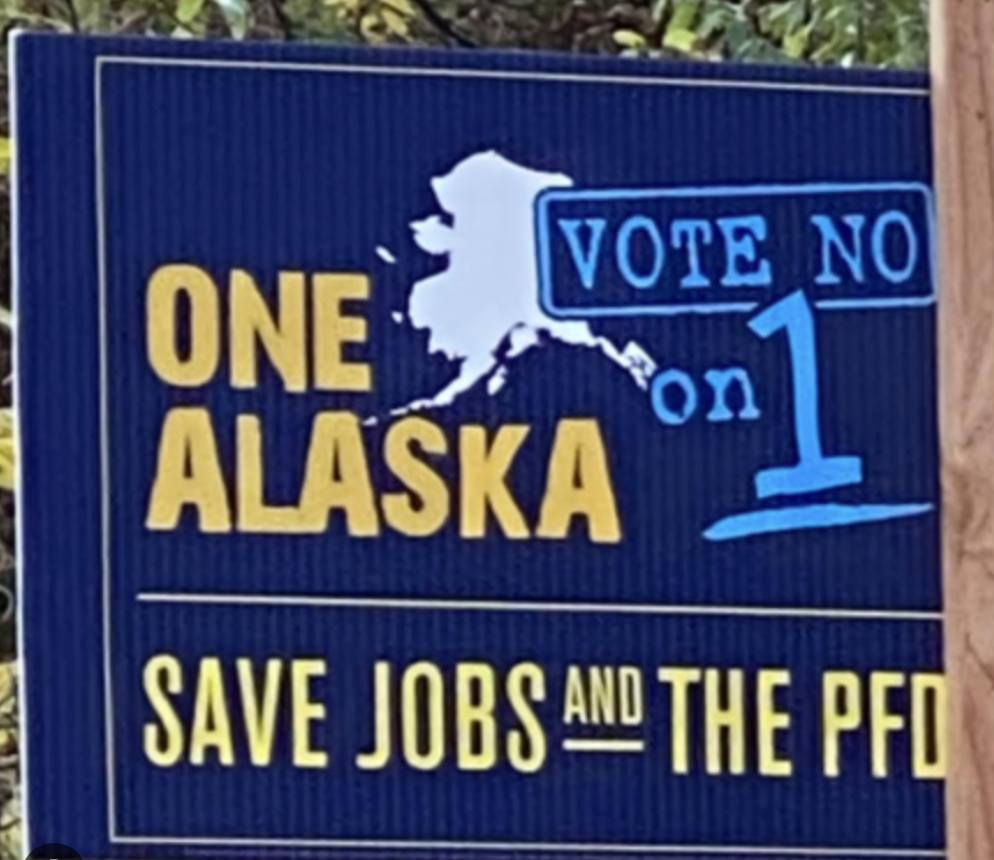
OneAlaska, a group funded with more than $25 million from the oil industry, led the drive to defeat a 2020 oil tax initiative. The initiative was defeated, but the industry never had a plan to “save jobs and the PFD.”