John Wood, attorney for 53 years, claims to be a non-attorney
The battle continues over whether long-time Alaska Attorney John W. Wood will fill a seat on the Alaska Judicial Council reserved under the Alaska Constitution for non-attorneys only.
Gov. Mike Dunleavy appointed Wood, 79, to a six-year term on the council as a non-attorney, even though Wood has been an attorney since 1972.
Dunleavy and his attorney general say that Attorney Wood is a non-attorney because he was suspended by the Alaska Bar Association for not paying his dues 25 years ago.
But Wood remains on the directory of the bar association as a suspended Alaska attorney, not a retired attorney, an inactive attorney, a resigned attorney, an emeritus attorney, a disbarred attorney or a non-attorney.
Suspended Attorney Wood, a former Dunleavy legislative employee, has been the recipient of a series of no-bid contracts that have kept him employed by the state throughout the Dunleavy administration, handling duties often performed by attorneys.
Wood, who is currently is getting $300 an hour from the state, has been a critic of government spending for decades. His total compensation during the Dunleavy years will be near $1 million.
Dunleavy wants Wood on the council to try to change the court system by promoting judicial nominees that agree with Dunleavy’s view of the courts. Judges are chosen by the governor from nominees forwarded by the council.
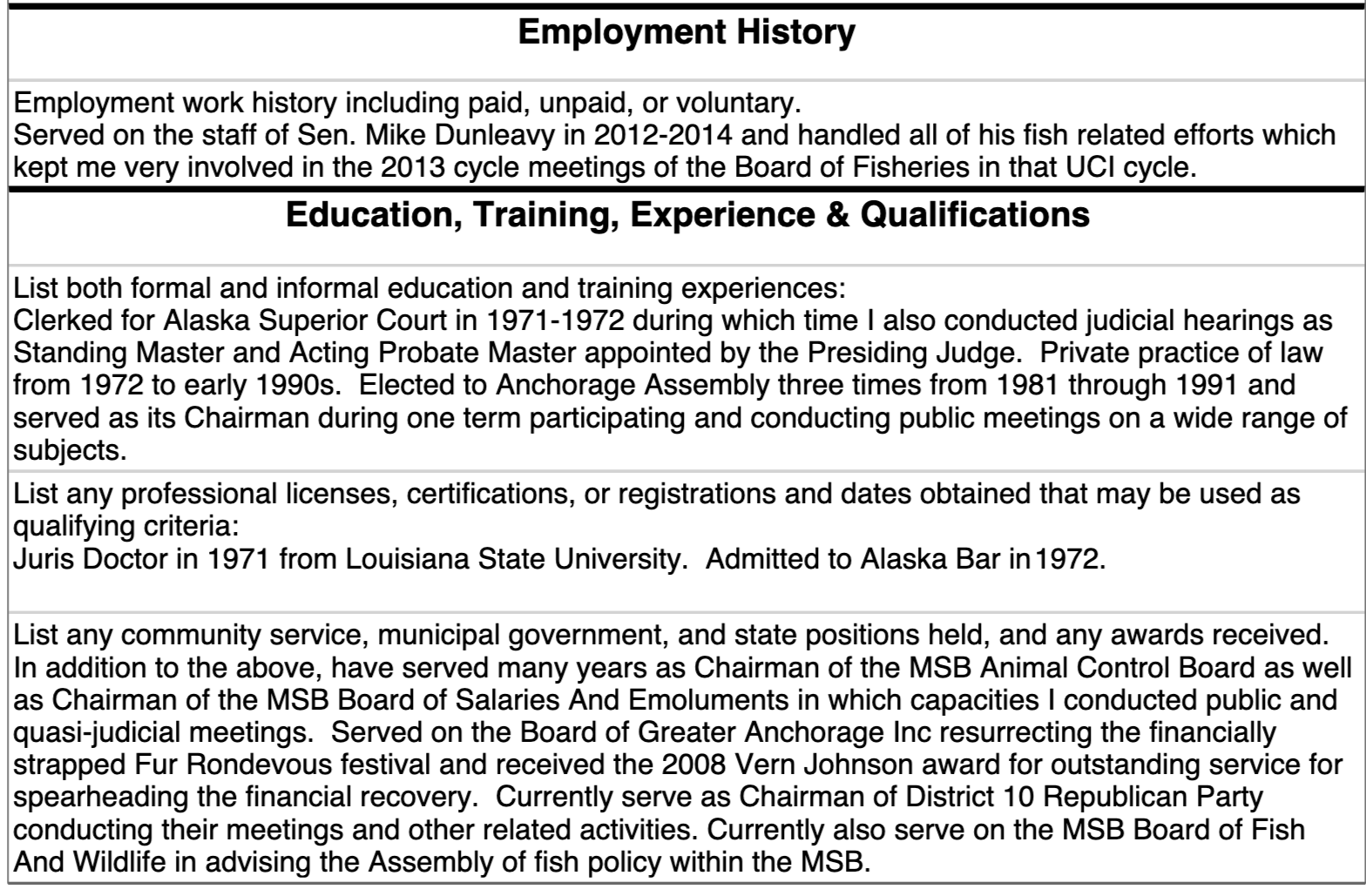
When Wood applied to serve on the fish board in 2019 and was appointed by Dunleavy, he did not claim to be a non-attorney. He said he had been a member of the Alaska Bar since 1972.
This is what he said about himself, which explains why the legislative clerks appended “Esq.” to his name in the minutes of his confirmation hearing.


The move by Dunleavy to place an attorney in a non-attorney seat drew a lawsuit from a nonpartisan group, Alaskans for Fair Courts, that supports the independence of the judiciary.
On August 28, just as Attorney General Tregarrick Taylor was on his way out the door to run for governor, he published an opinion saying that a key long-standing bylaw of the judicial commission is unconstitutional.
The bylaw in question says, “The chair of the Council shall administer the oath of office to each new member, following a determination by the Council that the person selected has met the qualifications for membership as set forth by law.”
The chair of the council is the chief justice of the Alaska Supreme Court, under the provisions of the Constitution that set out the process under which judicial nominees are selected and forwarded to the governor.
This opinion by Taylor relates to Wood’s appointment because the council has yet to decide whether Attorney Wood is eligible for the non-attorney position.
Taylor didn’t say why he wrote the opinion, but it was clearly prompted by Wood’s case.
“The council could determine that an appointee does not meet the constitutional qualifications for membership because he or she is not an ‘attorney’ or ‘non-attorney,’ or because he or she holds an “office or position of profit” for the state or federal government,” Taylor wrote, suggesting one of the alleged hypothetical ways in which the bylaw would be used.
“Any application of this bylaw would violate the constitution. The constitution leaves no room for the council to play a role in the appointment process. Instead, the constitution reserves this power solely to the governor and the legislature,” Taylor wrote.
“The bylaw usurps the governor’s power to appoint non-attorneys to the council, including during a recess,” Taylor says.
In an affidavit in the court case to establish his non-attorney status, Wood says “I left the legal profession in 2000, and I have not represented a client, provided legal services, or otherwise engaged in the practice of law since that time.”
The attorney general’s office claims that “Mr. Wood is not an attorney” because he is suspended.
“Being an attorney requires some ongoing engagement with the practice of law—something that Mr. Wood has not had for more than a quarter century,” the state says.
On Feb. 10, 1995, the Alaska Supreme Court publicly censured Wood, following his 1993 conviction in federal court for failing to file his federal taxes in 1987.
“Wood agreed to discipline by consent under Bar Rule 22(h) for engaging in conduct that adversely reflected on his fitness to practice law,” the bar association says in its account of the action.
All of the court filings can be found here.
Your contributions help support independent analysis and political commentary by Alaska reporter and author Dermot Cole. Thank you for reading and for your support. Either click here to use PayPal or send checks to: Dermot Cole, Box 10673, Fairbanks, AK 99710-0673.