
The president invites a Russian dictator to Alaska. It happened for the first time in 1943.
This is not the first time that a Russian dictator has been invited to meet a U.S. president at a summit meeting in Alaska.
President Franklin Roosevelt and Prime Minister Winston Churchill agreed to hold a World War II summit in Fairbanks in 1943, thinking the choice would be acceptable to Soviet dictator Josef Stalin, as they tried to arrange a spot for the first meeting of the Allied leaders.
Stalin claimed he liked the idea of meeting in Fairbanks, a gathering that would have changed the history of Alaska.
Most of what follows is from a column I wrote a decade ago about the proposed rendezvous in Fairbanks, which was the wartime transfer point for thousands of warplanes provided by the United States and flown from Fairbanks to Russia by Soviet pilots.
On May 6, 1943, FDR had offered numerous options for a summit site in a letter to Stalin and concluded, "I suggest that we could meet either on your side or my side of Bering Straits."
He said he wanted to meet Stalin one-on-one, with only one staff member and an interpreter, meaning without Churchill. FDR took pride in his powers of persuasion and thought he would do better with Stalin alone.
“I want to get away from the difficulties of large staff conferences or the red tape of diplomatic conversations. Therefore, the simplest and most practical method that I can think of would be an informal and completely simple visit for a few days between you and me,” Roosevelt wrote the Soviet leader.
“Such a point would be about three days from Washington and I think about two days from Moscow if the weather is good. That means that you could always get back to Moscow in two days in an emergency,” FDR wrote.
The preparations included an analysis of why Ladd Field, now Fort Wainwright, would be an acceptable meeting place. This document titled “Proposed Trip to Alaska or Iceland,” preserved in the FDR library, gives the details.
“The only single unit is the commanding officer’s house. This is a modern building with bedroom and bath accommodations on the first floor and several bedrooms and baths on the second floor,” the report said of Ladd Field.
The house would be made available, along with nearby apartments and barracks with a combined capacity of 300. “The personnel now occupying these buildings could be moved under canvas for the period of the visit,” the report said.
The families of officers and NCOs had never come to Alaska or been removed from Alaska at the time, making logistics easier. The Ladd Field hospital was 1,500 yards from the building where FDR and Stalin would have met.
“Security in this case offers no problem,” the document said.
There were 2,000 troops at the base and the possibility of air attack was nil because the nearest Japanese base was more than 2,000 miles away. Anti-aircraft guns could be moved in from Anchorage, if necessary.
The plan was to have FDR travel to Ottawa by rail and fly on a C-54 to Edmonton the first day, Fort Nelson the next day and Fairbanks the third day.
Fort Richardson in Anchorage, which had 12,000 troops, was proposed as an alternative. The report said a rail trip from Fairbanks to Anchorage “might be considered a hazardous one” because of the condition of the Alaska Railroad tracks.
Roosevelt told Stalin that Iceland would not be a suitable location because the flights were more difficult and it would be hard to exclude Prime Minister Winston Churchill.
When Churchill learned of Roosevelt wanting to meet with Stalin alone, he protested the idea and asked to be included.
On June 25, 1943 Churchill wrote to FDR that he had heard from U.S. envoy Averell Harriman of “your wish for a meeting with U.J. in Alaska a deux.”
U.J. was short for Uncle Joe, their shorthand for the tyrant.
“The whole world is expecting and all our side are desiring a meeting of the three great powers at which, not only the political chiefs, but the military staffs would be present in order to plan the future war moves and, of course, search for the foundations of post war settlement. It would seem a pity to draw U. J. 7000 miles from Moscow for anything less than this,” Churchill wrote.
“I consider that a tripartite meeting at Scapa Flow or anywhere else on the globe that can be agreed not only of us three but also of the staffs, who will come together for the first time, would be one of the milestones of history. If this is lost, much is lost,” he told FDR.
In any event, Stalin responded through FDR emissary Joseph Davies that he would meet with Roosevelt, but did not agree on a date or place.
“Stalin had no intention of roving far from home. He kept putting off the meeting, frustrating and reducing FDR to pleading,” historian Gary Kern wrote.
On August 15, while traveling to Quebec to see Roosevelt, Churchill said they should keep pressuring Uncle Joe about Fairbanks.
"After pondering this morning I feel pretty sure that we ought to make a renewed final offer to U.J. to go to meet him at Fairbanks or at the farther point you had in mind," Churchill wrote to FDR in a private note.
On August 19, 1943, Roosevelt and Churchill wrote to Stalin that they wanted to meet him in Alaska.a
“Neither Astrakhan nor Archangel are suitable, in our opinion. We are quite prepared, however, to go with appropriate officers to Fairbanks, Alaska. There, we may survey the entire picture, in common with you,” they wrote.
Five days later, Stalin said he could not go to Alaska.
“At a moment like this I cannot, in the opinion of all my colleagues, leave the front without injury to our military operations to go to so distant a point as Fairbanks, even though, had the situation on our front been different, Fairbanks would doubtless have been a perfectly suitable place for our meeting, as I indeed sought before,” Stalin said.
Two weeks later, Stalin said they should try to get together in Iran.
Even so, as late as October 26, Stalin said it might be a good idea to delay the meeting until the following spring, "at which time Fairbanks might be an appropriate place," according to a secret cable to FDR from Secretary of State Cordell Hull.
On November 8, 1943, Roosevelt said he would see the dictator in Iran. “I am looking forward with keen anticipation to a good talk with you,” he told Stalin.
Historian Paul Mayle said the four-day Tehran conference, which began November 28, 1943, was a "useful exercise in summit diplomacy." The heads of state discussed the preparations for the invasion of France that would take place the next year.
At a dinner, Roosevelt and Stalin talked in general terms about a lot of things, including the future of France, control of postwar Germany and where the three men might gather for their next meeting.
"Fairbanks seemed to be considered by both the most suitable spot," according to the secret conference minutes kept by Charles Bohlen.
In a telegram from Churchill to FDR on July 16, 1944, the prime minister said he would "brave the reporters at Washington or the mosquitos of Alaska" for another meeting and begin negotiating with "U.J." on the specifics. As it happened, Roosevelt was on his way to Hawaii and Alaska at that time, a trip that included stops in Juneau, Kodiak and the Aleutians.
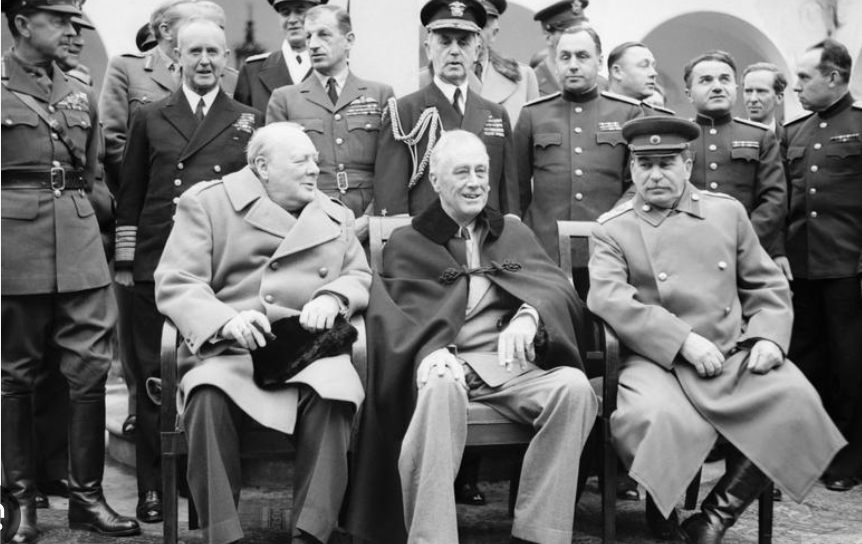
By this time, it should have been clear that Fairbanks was not on Stalin's bucket list. When he met with Roosevelt and Churchill for the last time in early 1945 it was not in Fairbanks, but in Yalta, where the three leaders made key decisions that for better or worse shaped the postwar world.
Your contributions help support independent analysis and political commentary by Alaska reporter and author Dermot Cole. Thank you for reading and for your support. Either click here to use PayPal or send checks to: Dermot Cole, Box 10673, Fairbanks, AK 99710-0673.