Sullivan stifles public broadcasting in Alaska by bowing to Trump's demands
In April, Sen. Dan Sullivan, a “Champion of Public Broadcasting,” told Alaskans that he supported federal funds for public broadcasting.
But Champion Sullivan and his spokeswoman, Amanda Coyne, are now claiming that he has long been warning public broadcasters that federal funding was in danger.
The truth is more troubling—Sullivan is again taking a knee to comply with Donald Trump’s edict to end support for the Corporation for Public Broadcasting.
Trump said on July 10 that anyone who supported public broadcasting “will not have my support or Endorsement.”
Sullivan, who is running for reelection in 2026, cast a key vote a week later to defund public broadcasting along will all other Senate Republicans, except Sens. Lisa Murkowski and Susan Collins.
After Sullivan performed as instructed, Trump praised him as “a GREAT man.”
The great man’s vote was never in doubt, even though Sullivan’s office sent a form letter to Alaskans in the spring pledging his support for public broadcasting funding.
“This is why I have again signed a letter to the Senate Appropriations Committee requesting continued support and two-year advance funding” for the Corporation for Public Broadcasting, Sullivan told constituents this spring who wrote him about public broadcasting.
On June 12, when the House approved Trump’s plan to eliminate funding for public broadcasting, Sullivan had a new story.
“It’s a bifurcated concern,” Sullivan told the right-wing Washington Times. “In states like mine, our rural radio stations play a really important role. So, how do you address that, while I am very unsympathetic to the program that comes out of National Public Radio? I’ve been telling those guys for years, it’s very left-wing, it’s very biased, and the government shouldn’t be subsidizing and funding left-wing media.”
The prepared statement Coyne sent to reporters after Sullivan voted to kill funding for public media repeated the bogus claim that Sullivan has long told public broadcasting outlets this was going to happen.
“For years, in numerous meetings, Senator Sullivan has been consistently warning executives from public media entities, the Corporation for Public Broadcasting, and NPR that their biased programming and reporting, funded in part by the American taxpayer, would eventually jeopardize federal support for both national and local radio stations,” wrote Coyne, a former journalist.
But Coyne is not telling the truth.
On February 26, 2020, Sullivan accepted the coveted “Champion of Public Broadcasting” trophy from America’s Public Television Stations.
He didn’t warn the assembled executives about the end of public funding. Far from it.
“I’m honored to accept this award from America’s Public Television Stations, and am proud to lead to the efforts to continue federal funding for local public media stations,” Sullivan said in a press release.
“Public media is crucial in providing education, public safety and in-depth news, information, and cultural programming to all Americans. In Alaska, and other rural states, local public broadcasting stations play a critical role in providing local information during disasters, and also in connecting communities. At a time when news outlets are shrinking, I thank public broadcasting and America’s Public Television Stations for their very important work in providing excellent community-based services.”
Patrick Butler, president of the public television group, said Sullivan was a “vigorous” supporter of public television who played the leading role in lining up Republicans senators to back funding for public media.
Sullivan gave this 15-miniute speech to the public television executives about the virtues of public broadcasting, how public radio and television is more important than ever in Alaska and throughout the country, how public media deserves support, etc.
“Our public media reporters based in Alaska are doing some of the best local reporting in the state and have been for decades,” Sullivan said.
He did not attack public broadcasting for biased programming and reporting or warn that Republicans like him would vote to defund public media.
The closest he came to was when he complained about the movement in Congress and the pressure from environmental groups to get banks to pledge not to back oil drilling in the Arctic. He said the reasons why that movement was bad for the nation and for Alaska Natives deserved coverage.
“So I think these are the kind of things that when we look at reporting on both sides, that it’s important,” he said.
“But I know you will do that,” he told the public media officials. “It’s certainly the best way to continue to receive bipartisan support.”
Sullivan has whined for years about all major news organizations that do not parrot his point of view on any particular story, while lavishing praise on companies and talking heads that never challenge his claims and accept everything he says as gospel—Fox News, Fox Business, One News Nation, Must Read Alaska, etc.
A year ago on July 11, he praised Suzanne Downing of Must Read Alaska in an obsequious tribute placed in the Congressional Record, though he didn’t make her Alaskan of the Week, perhaps because of her strong ties to Florida, where her husband, Pat Yack, is executive director of Florida Public Media.
Two years ago he stood in front of a Washington VFW building and tossed paper copies over his shoulder of headlines he didn’t like in the Washington Post, New York Times and the PBS News Hour.
The stories were all about House Republicans inserting culture war issues in the defense budget to counter efforts by the Biden administration.
Sullivan claimed it was the Biden administration inserting culture war issues. Had he read beyond the headlines, he might have understood that both points of view were covered.
This is the News Hour segment he claimed was biased, though he did not identify any errors.
Sullivan has never been a reliable judge of news coverage. He is happy only with stories that he agrees with.
After Sullivan broke his promise about supporting funding for public broadcasting, his office began to issue static about allowing the “most rural” stations to get some money diverted by the Trump administration from other purposes already approved by Congress.
South Dakota Republican Sen. Mike Rounds claimed to have made a side deal with Trump officials that $9.4 million in “unused climate change money” will be handed out to “dozens of tribal radio stations” in 11 states.
Coyne claimed that “Alaska Native” radio stations could compete for some of that money. Alaska doesn’t have “Alaska Native” stations or tribal stations.
The diversion is “neither administratively feasible nor fiscally sustainable in the short term,” wrote Loris Taylor, president and CEO of Native Public Media in Arizona.
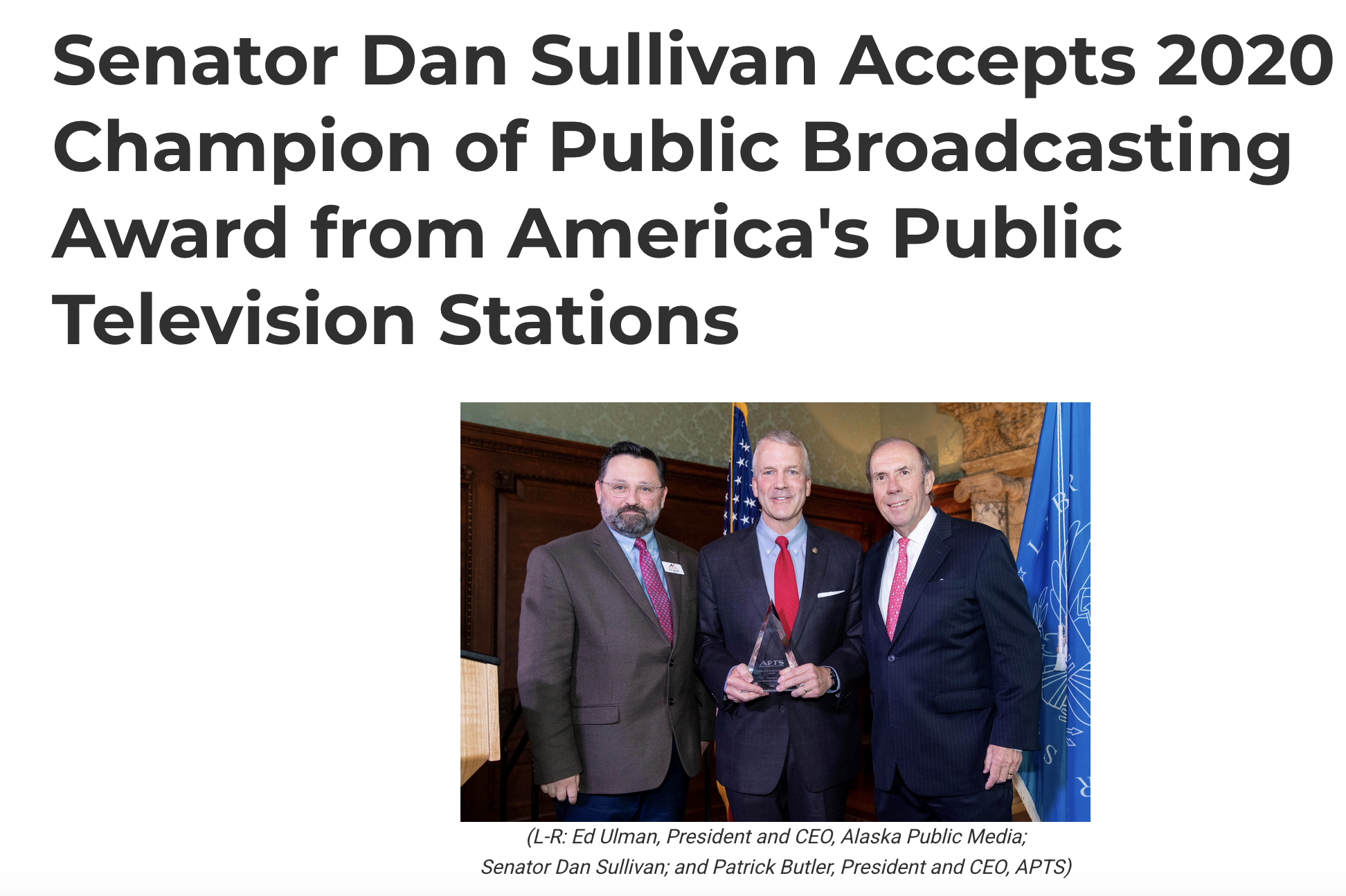
In 2020, Sen. Dan Sullivan said he was “proud to lead the efforts to continue federal funding for local public media stations.” Sullivan voted this month to end federal funding for public broadcasting.
DUNLEAVY DEBACLE 2025: Look for a one-day special session this weekend, a total waste of money brought to you by Gov. Mike Dunleavy, who has ordered legislators to Juneau without doing any of the real political groundwork necessary for success.
The only bright spot is that Senate and House members plan to meet in joint session at about 10:15 a.m. to consider overriding Dunleavy’s education veto and his attempt to keep oil and gas tax audits secret.
Senate President Gary Stevens and House Speaker Bryce Edgmon said “the Legislature intends to adjourn later that day, having completed its work.”
Stevens said this in a press release: “This special session was called under circumstances that raise serious concerns, not only about its timing but also its clear aim to complicate legislative participation. Nevertheless, I urge every lawmaker not formally excused to be present in Juneau to fulfill our constitutional duty. These override votes are not just symbolic. They are about preparing Alaska’s students, restoring public trust in how we manage billions in state revenues, and maintaining the Legislature’s role as a co-equal branch of government. We owe it to our constituents and the future of this state to show up and do our jobs.”
Edgmon said: “Alaskans expect us to lead, not walk away from our responsibilities. Families, students, and teachers are counting on us to follow through on the commitments we made during the regular session. We passed strong bipartisan legislation this year that not only provides much-needed resources to our public schools but also reflects the will of the vast majority of Alaskans who participated in the legislative process. This special session is not about partisanship, but about standing up for our students and preserving the checks and balances that keep government accountable. Every elected state lawmaker needs to uphold their constitutional duty, come to Juneau, and vote their conscience.”
Here is a joint letter from Stevens and Edgmon about the need to override Dunleavys’ vetoes.
Dunleavy took to social media to complain that the education policy plans he offered this past year should be heard during the special session, but he lost all credibility on this issue when he told his Republican allies to avoid attending the special session at the start to make it impossible to override his vetoes.
The vetoes really should be overridden. All of the rest can wait till next year.
Your contributions help support independent analysis and political commentary by Alaska reporter and author Dermot Cole. Thank you for reading and for your support. Either click here to use PayPal or send checks to: Dermot Cole, Box 10673, Fairbanks, AK 99710-0673.