Rep. Kevin McCabe says the budget is bloated, but he found only $8 million in cuts
With Gov. Mike Dunleavy in absentia, a divided Legislature is left grappling with Alaska finances when there is no fiscal plan, no hope of a fiscal plan and no leadership.
It would not be complicated to fix this. It would take a modicum of political courage, however.
Alaska needs taxes to create a sustainable budget and provide the services a modern state requires. We need to end the Hilcorp loophole, cut oil company tax credits, raise the fuel tax, cap the dividend, raise mining taxes, withdraw more money from AIDEA’s earnings and take a few other steps to create a sustainable future for Alaska.
But the Legislature is handicapped in pulling this off because the governor’s mind is elsewhere and there are a few dozen fiscal fantasists wandering the Capitol who keep peddling the same old piffle.
Many Republicans, and some Democrats, want to grandstand on the Permanent Fund Dividend, a tactic that has worked for generations of our worst elected officials.
To me, the theatrical performance this week of Rep. Kevin McCabe is a good example of what is lacking in the Legislature today.
But first, let’s allow Kevin and his wife Linn to speak for themselves.
They really like to talk about bloated state government.
“Another day of beating heads against the wall—the ‘wall’ being the leftist Democrat binding caucus, which won’t allow any spending cuts to their BLOATED, and UNBALANCED budget. They will cut YOUR PFD before they allow any government agencies to be affected. Backward priorities! Sadly, you and the private sector take the backseat to government interests,” Linn McCabe shouted on Facebook.
The Republicans beating their heads against the wall of bureaucratic bloat include her hubby, who sees a swollen government wherever he looks.
In March, Kevin complained about the “bureaucratic bloat of the education-industrial complex.” In April, he promoted claims that the Anchorage school district has a “bloated administration.”
On Wednesday, Kevin said Democrats would rather “raid the PFD and protect bloated bureaucracies” than “cut a dime of excess.”
“Faced with a bloated, unfunded budget, the House Democrat caucus voted down every single Republican amendment aimed at reducing costs or increasing transparency. I proposed seven amendments totaling over $8.3 million in savings or redirection, and none passed—except for one critical investment in public safety,” Kevin said Tuesday.
I had to read that sentence a couple of times to make sure I understood.
I’m sure he couldn’t possibly mean that he was proposing just $8.3 million in bloat reduction. That’s not even a pinprick in the war on bloat.
Any observer of Alaska’s “BLOATED and UNBALANCED” budget should be able to come up with at least $800 million in amendments to cut the budget. It must be that Kevin forgot to mention the $792 million in excess lard that he wants to remove.
In 2019, Gov. Mike Dunleavy nearly doubled that number and proposed $1.5 billion in budget cuts, promising a “real honest budget” that everyone would understand.
“We are now preparing a budget that for the first time all Alaskans will be able to understand and trust,” Dunleavy said on January 22, 2019. “No more games, no more shuffling numbers, just an honest straightforward look at where we are.”
“As I promised the people, we must start from the standpoint that expenditures must equal revenues,” he said. “We can’t go on forever using savings to plug the gap.”
“As we’ve all seen, for too long, politicians haven’t been honest when it comes to the numbers and the seriousness of our fiscal woes,” he said in a press release that most of the state’s newspapers printed verbatim in 2019.
“As your governor, I will always be honest with you,” he said.
The last six years have brought us no end of games, shuffling numbers and dishonest budgets.
This year Dunleavy proposed that expenditures should exceed revenues by $1.5 billion. He acts as if we can go on forever using savings to fill the gap. He has once again promised a giant dividend and taken no steps to balance the books.
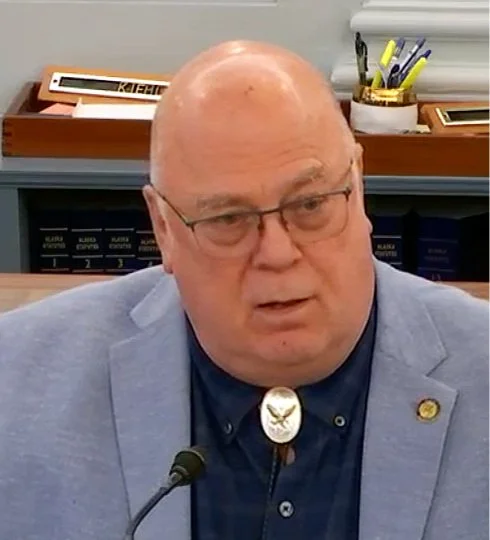
Rep. Kevin McCabe.
Some of the McCabe amendments to reduce the swollen government demonstrate that government bloat is in the eye of the beholder. He said he wanted to cut money for University of Alaska sports by $4 million, $1.2 million from public broadcasting and $900,000 from the arts.
More than one-eighth of his anti-bloat plan was to eliminate the Alaska Public Offices Commission, which exists to provide information to the public about candidates and financial information about elected officials.
“If you will all hold your applause until I am completely done, this amendment deletes all funding from the Alaska Public Offices Commission, totaling $1.2725 million. Why you might ask? Because it’s duplicative,” McCabe said Monday night.
A couple of representatives clapped.
He went on at length in a speech that should be a lesson to anyone who hopes to understand the shallowness of the anti-bloat brigade.
“Alaskans and candidates for federal offices already comply with Federal Election Commission rules. That’s a robust and functioning agency with infrastructure to provide transparency and accounting, accountability in campaign finance. Maintaining APOC is a duplicative and unnecessary use of state resources in a time when we’re scrutinizing every dollar and asking Alaskans to sacrifice especially when it comes to their PFD. We must eliminate spending wherever we can especially if it doesn’t provide a unique value or if it’s duplicative as I said this one is. The FEC is fully capable of handling campaign finance disclosures. There’s no justification for continuing to fund a separate overlapping bureaucracy at the state level,” Kevin said.
“This is about responsible budgeting Mr. Speaker and eliminating wasteful duplication,” he said.
North Pole Rep. Mike Prax, who famously didn’t know how he voted on the education bill in February, had praise for McCabe’s pontification.
Prax said most voters don’t care or pay attention to the APOC. Instead of requiring APOC campaign finance disclosures, “we should just listen to what people say and take it at that.” In other words, elections would be improved if we ignored the money and just listened to campaign blabbing.
Eagle River Rep. Jamie Allard said she didn’t like the overwhelming financial disclosure requirements of the APOC and said a school board member has to disclose more than the president. “We need to go with the FCC (sic) and how they report,” she said.
The Federal Communications Commission has nothing to do with elections.
From watching and listening to the proceedings, it appeared that Kevin McCabe decided that he didn’t need to know anything about Alaska election disclosure law before pretending to be an expert.
He had no idea that the FEC has no role in state elections and no power to regulate state elections. Contrary to his claims, the APOC does not duplicate what the federal agency does. He was completely wrong.
The Federal Elections Commission deals entirely with federal elections for Congress and president.
What we learned from this amendment is that multiple members of the Legislature are ignorant about an elementary aspect of state government.
Informed legislators, even those who don’t like the APOC, know that it is one of the most productive, cost-effective and smallest agencies in state government. It has seven employees at the moment, with one vacancy that it is struggling to fill. It has another vacancy that is being left open because of “budget constraints.” It does not duplicate the work of the FEC.
But Kevin kept doubling down on his mistake even after Juneau Rep. Sara Hannan pointed out that state candidates have no contact with the FEC.
He claimed the Legislature created the APOC, apparently unaware that the agency’s roots are in a 1974 Watergate-era initiative.
“APOC has become, like all agencies that we created in this body at one time or another, has become a burgeoning bureaucracy that are now coming up with their own regulations and their own timing on reports and making it more and more difficult for us as candidates and less and less difficult for them,” he said.
“I think that the FEC is a well-established method for reporting your campaign finance donations, and I think we should lean on them. I think we should use them as much as we can. They're there. They provide the transparency that we need,” he said.
The FEC is not a method for reporting state campaign finance donations. There is nothing to lean on.
Perhaps Kevin is clueless about all of these matters because his wife Linn prepares his APOC reports and he has never bothered to educate himself. Linn was the chair and treasurer of his 2024 campaign.
Kevin McCabe must be aware that there are three APOC complaints pending at the moment that involve Kevin McCabe. He filed one of them, while two were filed against him.
The first complaint was filed by Kevin McCabe against Michael Alexander, who put up campaign signs next to McCabe signs that called McCabe a “PFD thief.” McCabe said Alexander had failed to register.
Here is the APOC staff report recommending a $150 fine against Alexander.
On December 27, 2024, Alexander filed a complaint against McCabe saying he failed to disclose campaign advertising. McCabe said this complaint was retaliation.
The existence of these complaints created a conflict of interest that should have prevented McCabe from proposing to eliminate the agency.
In the end the amendment to eliminate the Alaska Public Offices Commission failed 11-29. That was the right decision.
McCabe, Allard, Prax and fellow Republicans Julie Coulombe, Bill Elam, George Rauscher, Rebecca Schwanke, Cathy Tilton, Frank Tomaszewski, Jubilee Underwood and Sarah Vance voted to eliminate campaign disclosure and finance enforcement in Alaska.
Your contributions help support independent analysis and political commentary by Alaska reporter and author Dermot Cole. Thank you for reading and for your support. Either click here to use PayPal or send checks to: Dermot Cole, Box 10673, Fairbanks, AK 99710-0673.