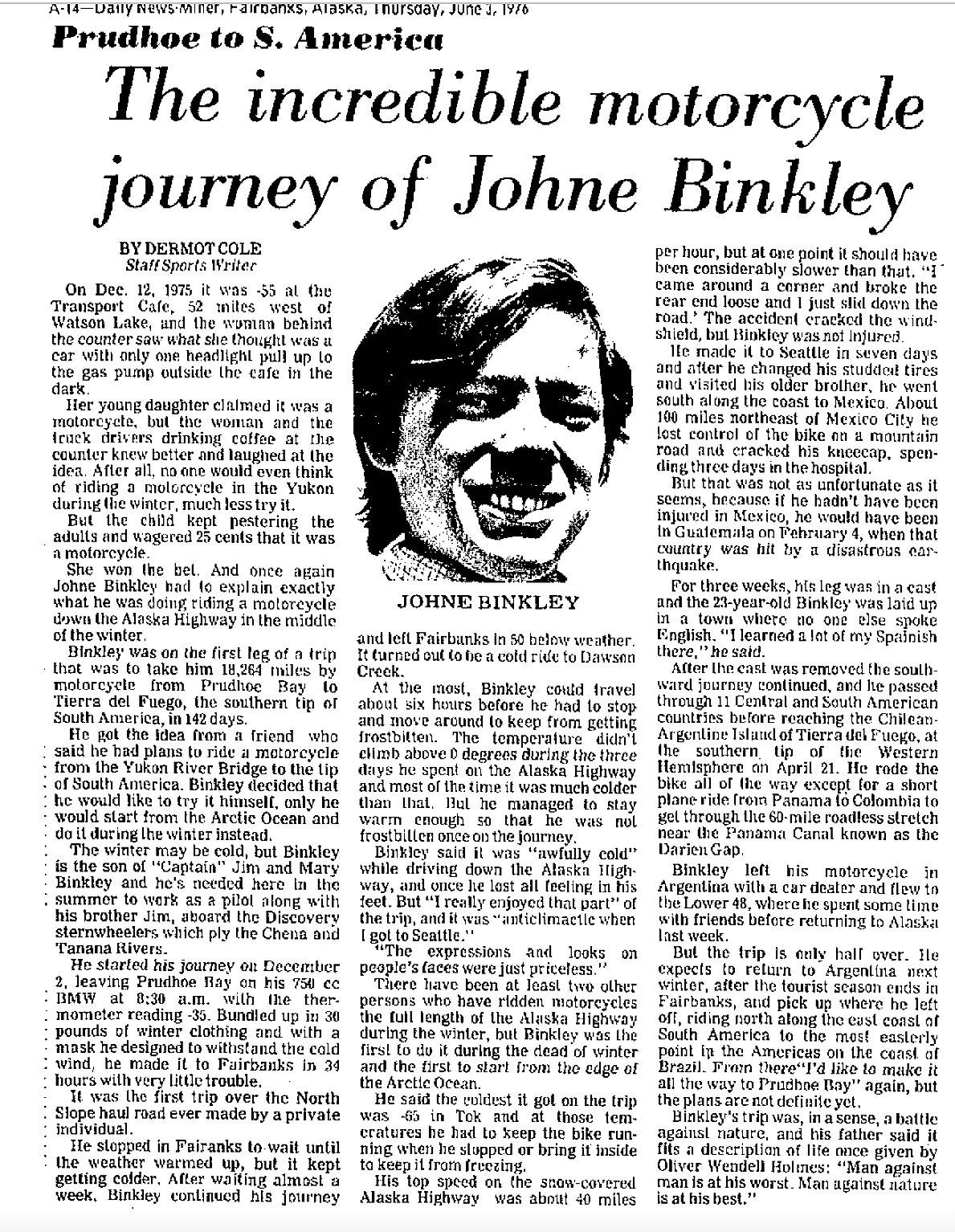
The incredible motorcycle journey of John Binkley, 50 years later
It was 35 below when John Binkley pulled out of Prudhoe Bay on a BMW 750cc at 8:30 a.m. on December 2, 1975. He was there to begin an expedition that would take him to the southern tip of South America in 142 days.
Binkley, then a hearty 22-year-old, became the first of hundreds or thousands of people to complete that journey from the Arctic Ocean, a road trip made possible by the completion of the Yukon River Bridge in the fall of 1975.
The urge to be first was one reason why he started at the darkest and coldest time of the year. Also, he had to be back in Fairbanks by the summer to work on his family’s tourist business, the Riverboat Discovery, which made a summer start a no-go.
The rough gravel road from the Yukon River to Prudhoe Bay was owned by the oil companies at the time. It was all but impossible for people not connected to the pipeline project to get access, but Alyeska public relations man Larry Carpenter, with encouragement from the likes of the late Mike Dalton, had given Binkley a permit to use the road in November.
Binkley learned of opposition to his trip from higher-ups in the Alyeska food chain after pipeline executives and Alaska political leaders gathered at Eielson Air Force Base on November 29, 1975 to greet President Ford, who stopped for fuel on his way to China.
John’s father was the emcee at the Eielson event and when Alyeska President E.L. Patton learned about the crazy motorcycle plan, he decided to yank the permit.
Phone service in Fairbanks was completely unreliable at the time, which meant doing lots of communication by mail, not phone. Binkley decided he had to get to Prudhoe before a letter from Patton made cancellation of the permit official.
He went to the Fairbanks airport and got onto the first Alaska International Air Hercules that had space for him and his bike. Even after the opening of the Yukon River Bridge, the AIA Hercs were a constant presence in the skies over Fairbanks.
Once Binkley got to Prudhoe, a quick editing job by Binkley with a bit of whiteout and an electric typewriter extended the Alyeska permit for the last month of 1975.
That was all he needed to get on the road at what was hardly the most wonderful time of the year.
I still can’t believe that his parents, Jim and Mary Binkley, didn’t talk him out of doing this, but then again he was no novice to outdoor adventure, having raced snowmachines and motorcycles since he was a young teenager.
Riding across Alaska in the winter was a dangerous trip, no question about it. But Binkley said his parents gave him a lot of freedom growing up and he wasn’t reckless, just determined. He was also competitive.
Any winter trip by motorcycle is hazardous because ice and snow are not conducive to staying upright on two wheels.
Add the wind, frigid temperatures, zero visibility, darkness, the potential for frostbite, isolation, the lack of emergency assistance, accident risks in the middle of nowhere, the risk of disappearing into a snowdrift or going off a cliff and truck drivers who were not looking out for a BMW on that rough industrial road. It had all the ingredients of a survival story in which the principal character would not survive.
He had about 30 pounds of clothes, including bunny boots, multiple layers of wool, and a helmet that included duct tape and a snorkel so he could breathe without fogging up his mask. He had to stop every hour or so to knock the ice off the snorkel. He wore a long wool scarf, wool sweater, wool long underwear and down-insulated pants and two down parkas. His top speed was about 60 mph.
This month, on the 50th anniversary of the start of his frigid ride, Binkley, now a hearty 72-year-old, pulled out of Prudhoe Bay on a motorcycle with the temperature at zero and winds at 15 mph. That makes for a cold ride.
This time he had a modern snowmachine helmet, better clothes and a more limited goal. He planned to go south, just not that far south. Things didn’t go exactly according to plan, but he survived and rode hundreds of miles.
As with his first trip all those years ago, I can’t believe that his family didn’t talk him out of doing this.
He did make some concessions to safety that were missing the last time he left the Arctic Ocean, namely the presence of a support crew—his son James and his daugher Kai Binkley Sims—who followed him in a pickup pulling a supply trailer. He had heated gloves, a luxury unknown in the old days, but his hands got cold before he realized they weren’t plugged in. The trailer contained extra parts and a backup bike.
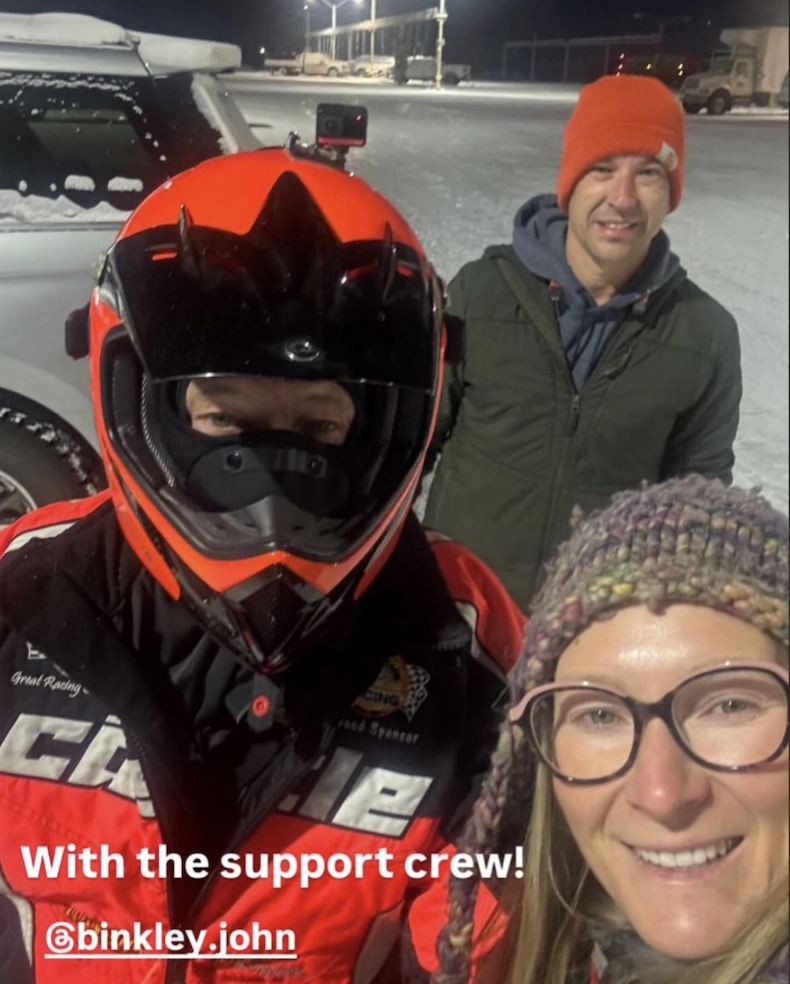
John Binkley prepares to leave Prudhoe Bay 50 years later, backed up by James Binkley and Kai Binkley Sims.
Not long after he started on his anniversary ride, the windshield broke off his bike after he hit some really bumpy ice patches on the Dalton Highway.
It was not the original motorcycle because he left that one in South America. It was a 1975 BMW he bought from a guy in North Pole after he decided to re-enact the first part of his intercontinental tour.
In an Instagram post by Kai, Binkley recalled how he packed his pockets with rags 50 years ago. He said whenever he felt the cold air sneaking through his layer of clothes, he would stuff a rag into the hole to try and plug the leak.
In 1975, it took him 34 hours to reach Fairbanks, a trip he made without a support vehicle, riding on tires modified with studs he applied for traction. He enhanced his tires in a similar fashion this time.

Johne Binkley with his homemade headgear for his 1975 winter motorcycle trip.
A half-century ago in Mexico he had an accident that put him in a cast for three weeks. It was one of the luckiest things that ever happened to him.
Binkley lost control on a mountain road and broke his kneecap. If he hadn’t been delayed that way he would have been in Guatemala on February 4, 1976 when a massive earthquake struck, killing 23,000 and injuring 76,000.
On his 2025 ride, Binkley ran into some trouble on the ice after an oversized oncoming truck kicked up a lot of snow north of the Brooks Range. He had moved over as far as he could and hit a rough patch that knocked him for a loop.
“When you are on the ice riding a motorcycle you can’t make moves quickly,” he said the other day. “You make small corrections even as you are getting tossed in icy ruts.”
He was making course corrections when his front tire hit a bad spot and “flipped me over to the left of the road and the bike went back to the right and skidded off into the ditch.”
“The part that scared me about that was that I got thrown right over onto the other side of the road,” he said.
He wasn’t injured. After sizing up the situation, he figured he should just pull over and wait whenever there was oncoming traffic. That’s something he wouldn’t have done 50 years ago. He said his son and daughter were more tense than he was about the accident.
Binkley and his support crew retrieved the bike from the ditch and he kept riding, with a brutal crossing of Atigun Pass and the drive down to Coldfoot where they spent the night.
John and James worked on the spare bike that night and fixed a fuel problem, so he could ride the backup bike the rest of the way.
He crossed the Yukon River and headed toward Livengood, which he reached at about the time exhaustion set in. It is physically demanding to ride on the ice and stay upright because the brakes don’t work well even with studded tires.
Now he’s not only the first person to ride a motorcycle from Prudhoe Bay to the tip of South America, he’s also the first 72-year-old to ride a motorcycle from Prudhoe Bay past the Yukon River in December.
While his original trip covered more than 18,000 miles, Binkley said he didn’t think about trying to repeat the entire route, just the portion that crossed northern Alaska.
December of 1975 was really cold, as I remember it. Binkley stopped for about a week, hoping for a break in the weather. It didn’t happen.
He left Fairbanks at 53 below and it hit 64 below near Tok. He was on his way as far south as it is possible to go on land.
“It was a transformative experience for me,” he says now of his long ride. “It gave me the confidence to do a lot of things on my own.”
It was also, in a small way, a transformative experience for me.
I took a great interest in his 50-year re-enactment not just because it was an impressive achievement for a guy the same age as I am, but because I interviewed Binkley in 1976 after he returned to Fairbanks from his trip. Back then his first name was spelled with an “e” at the end.
It wasn’t a first-rate piece of journalism, but it was something I worked on for a few days and it was the first story I ever wrote that was not a simple tale of a baseball game. I’ve never forgotten it.
It was one of the countless thousands of newspaper stories I wrote in an attempt to try to learn how to write. I am still trying. Unlike riding a bike, learning to write is a process in which you have to keep learning no matter how long you have been at it.
The headline on that piece 50 years ago was “The incredible motorcycle journey of Johne Binkley.” A trip most of the way to Fairbanks by motorcycle from Prudhoe Bay also qualifies as incredible at 72.
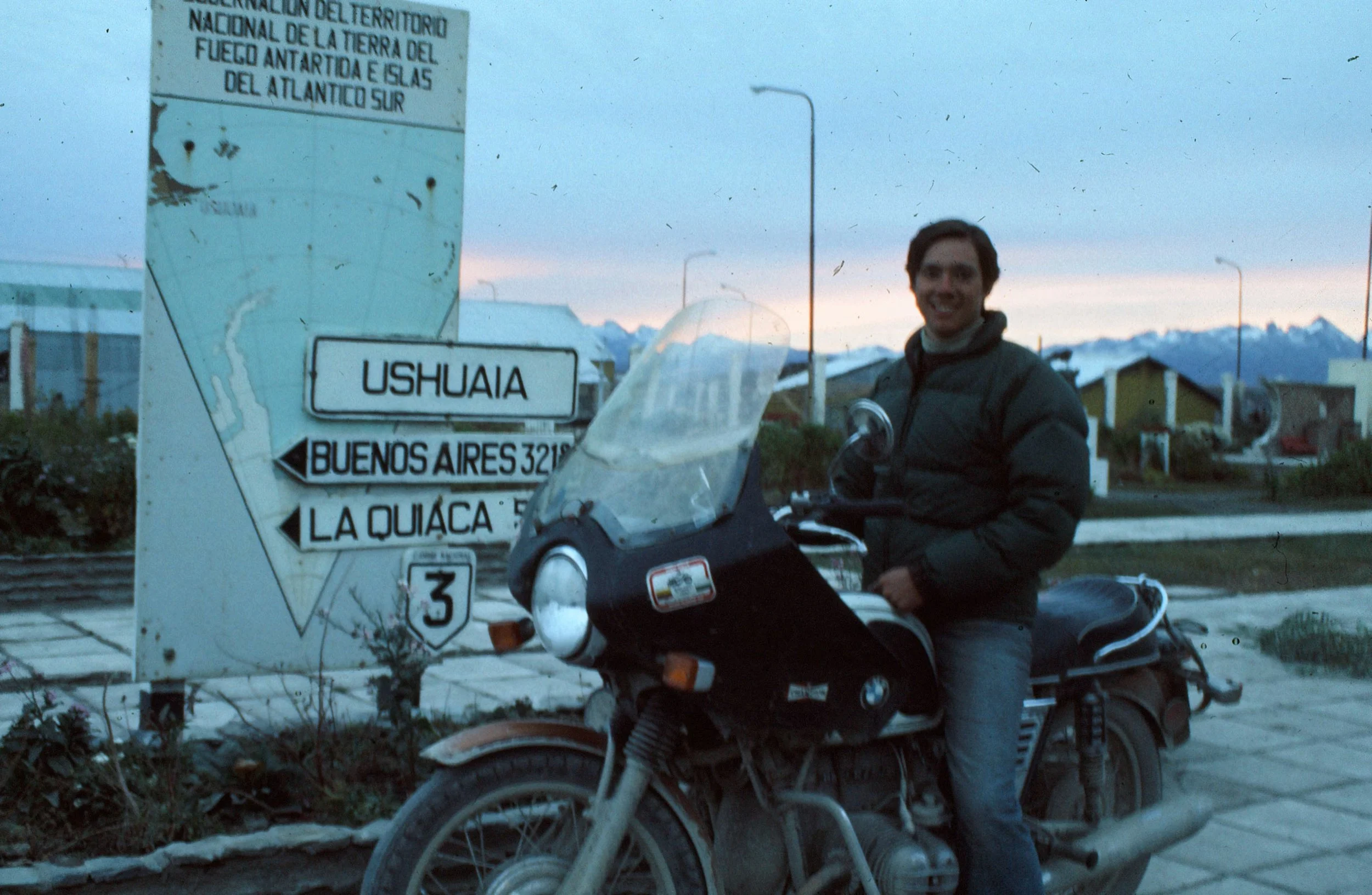
Binkley arriving in Ushuaia, the capital of Tierra del Fuego, the world’s southernmost city.
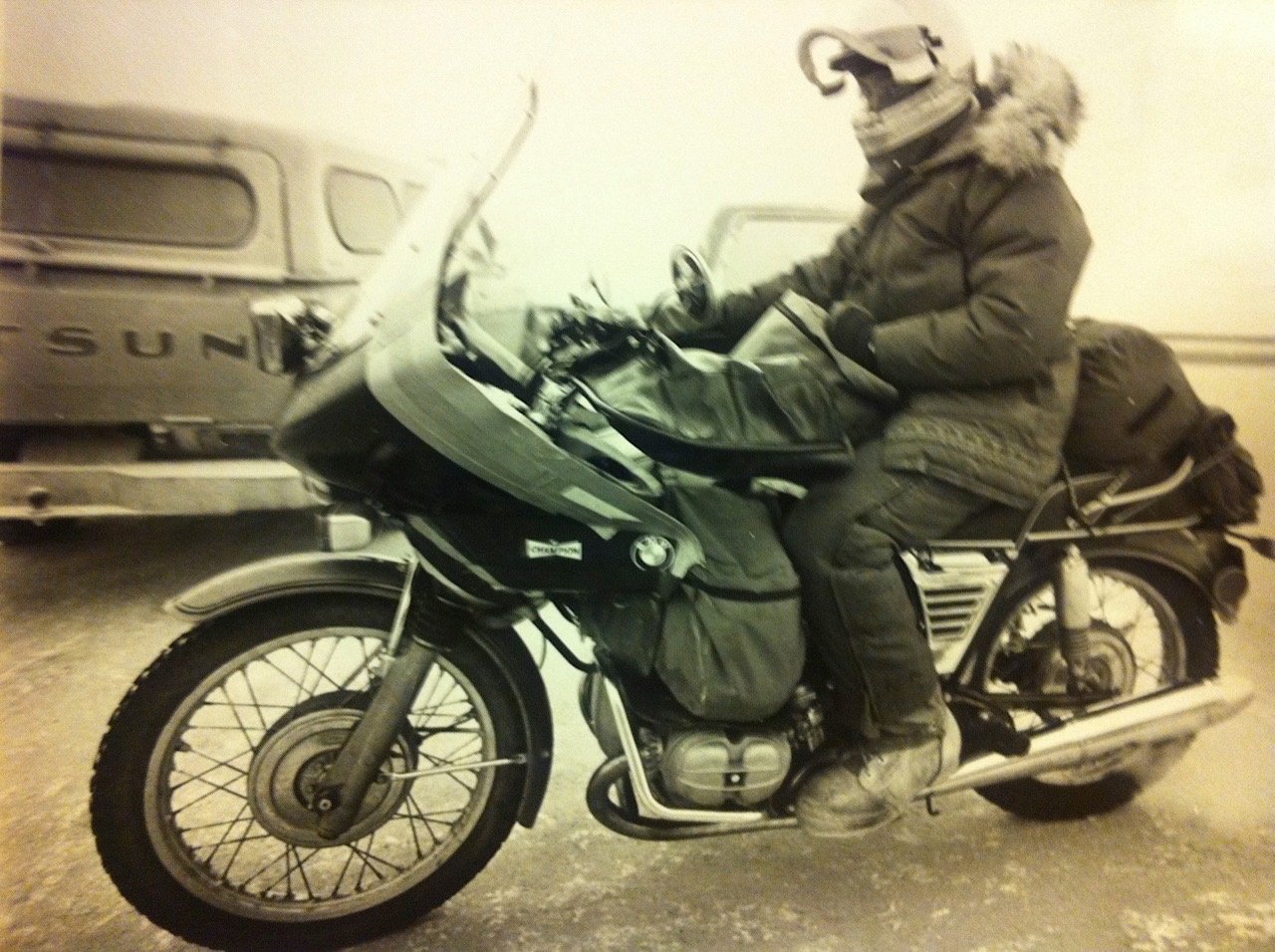
The clothes, boots, and helmet that Binkley wore in 1975 on his winter bike trip weighed about 30 pounds.