Alaskans deserve plan to stem decline in state services
The national rate of tuberculosis is 2.5 cases per 100,000 people. In Alaska, there are 13 TB cases per 100,000 people, the highest rate in the nation.
This alarming statistic is one reason why there has been a task force in the Yukon-Kuskokwim region combating the disease.
But there is bad news for TB patients, their families and communities. Last week, the state laid off six of 12 nurses who dealt directly with patients as part of this task force.
The nurses were long-term non-permanent state contract employees. I have been told that the layoff has been blamed variously on an administrative error or a mixup in paperwork.
Some of the nurses were told Friday that they would be out of work on December 31st. Others didn’t learn that their jobs were eliminated until Monday.
“We were told that our new contracts were not submitted on time, that it was an administrative error and nothing could be done about it,” one nurse told me. “As nurses, we can /will find other jobs however, what about our clients?”
The nurses had from one day to four days notice that they were losing their jobs and would not have health insurance.
I wrote to Health Commissioner Heidi Hedberg and Public Health Nursing Section Chief Kelly Tschida on Tuesday that the lack of notice to the employees and the lack of notice to the patients struck me as unreasonable.
The department leaders did not respond to my specific questions.
Instead, a public relations employee wrote: “The positions you have referenced were budgeted as non-permanent positions that expired on December 31, 2024. We have encouraged these employees to explore future permanent employment opportunities within the Section of Public Health Nursing, where their skills and commitment can continue to contribute to the health and well-being of Alaskans. We deeply appreciate the hard work and dedication of these employees to supporting tuberculosis treatment efforts across the State of Alaska and the Division of Public Health is proud to have a dedicated team of professionals working specifically to address tuberculosis (TB) in our communities.”
The questions remain about why the employees were given almost no notice and why the patients were given no notice. The nurses told me that in early December they were told the jobs would continue until next summer.
In any case, a properly functioning agency would not perform in that manner.
These questions and the assertion about an administrative error deserve a response from Hedberg and Tschida. The state has had a lot of trouble recruiting nurses. Incidents of this kind won’t help.
This is just one of many examples of a decline in a state service that takes place without a public acknowledgment that it is happening.
The information about cutbacks in service comes out in bits and pieces, a haphazard situation in which the executive branch of state government has failed to document the seriousness of the matter or present an overall plan to fix it.
Two years ago the state said it had a 16.7 percent vacancy rate. There is no coherent reporting from the Dunleavy administration about the consequences.
Delays in response time and closures have become prevalent for many routine aspects of government.
“The Fairbanks Youth Facility treatment unit has been closed until staffing levels meet the appropriate threshold for safe and functional operation,” the Department of Family and Community Services says.
“Please expect possible delays past our normal 10-15 business day (2-3 week) processing time for any forms submitted hard copy,” the corporations section of the commerce department says.
The number of people living at the Fairbanks Pioneers Home has been reduced because there are not enough workers to operate the home at full capacity.
The backlog in dealing with applications by poor people for food assistance and other anti-poverty programs has received the most public attention. The state is supposed to respond to public assistance applications within 30 days, but the processing delays have led to a court case that goes to trial next week.
Death certificates, issued by the health department, now take three months. Expedited service is no longer available.
The vacancy rate for state workers is now 13.9 percent for permanent full-time employees, 23.2 percent for permanent part-time employees and 60.1 percent for temporary workers.
The vacancy rate in the health department is 19.4 percent for all employees.
Credit the Anchorage Daily News for seeking details from the Dunleavy administration on vacancy rates in each department, as shown in the chart republished below. This is not information that the state has chosen to highlight. There are vacancies everywhere.
The newspaper included this in a good report on staffing problems and the governor’s refusal to release a draft salary study that cost at least $800,000.
While staffing shortages have received national attention and have been a problem across Alaska, we need to hear from the governor about the real decline in state services on his watch, what he’s doing to fix the growing problems, the impact on Alaskans and how much it will cost to turn things around.
He hasn’t provided a recovery plan, much less how he would pay for one without increasing his proposed $1.5 billion deficit. Dunleavy refuses to propose taxes, promoting a fiscal fantasy instead.
A lot of these issues grew much worse during the pandemic, a catastrophe that was beyond anyone’s control. But we’re past the point where officials can use COVID as an all-purpose excuse for failing to rebuild state services.
Your contributions help support independent analysis and political commentary by Alaska reporter and author Dermot Cole. Thank you for reading and for your support. Either click here to use PayPal or send checks to: Dermot Cole, Box 10673, Fairbanks, AK 99710-0673.
Write me at dermotmcole@gmail.com.
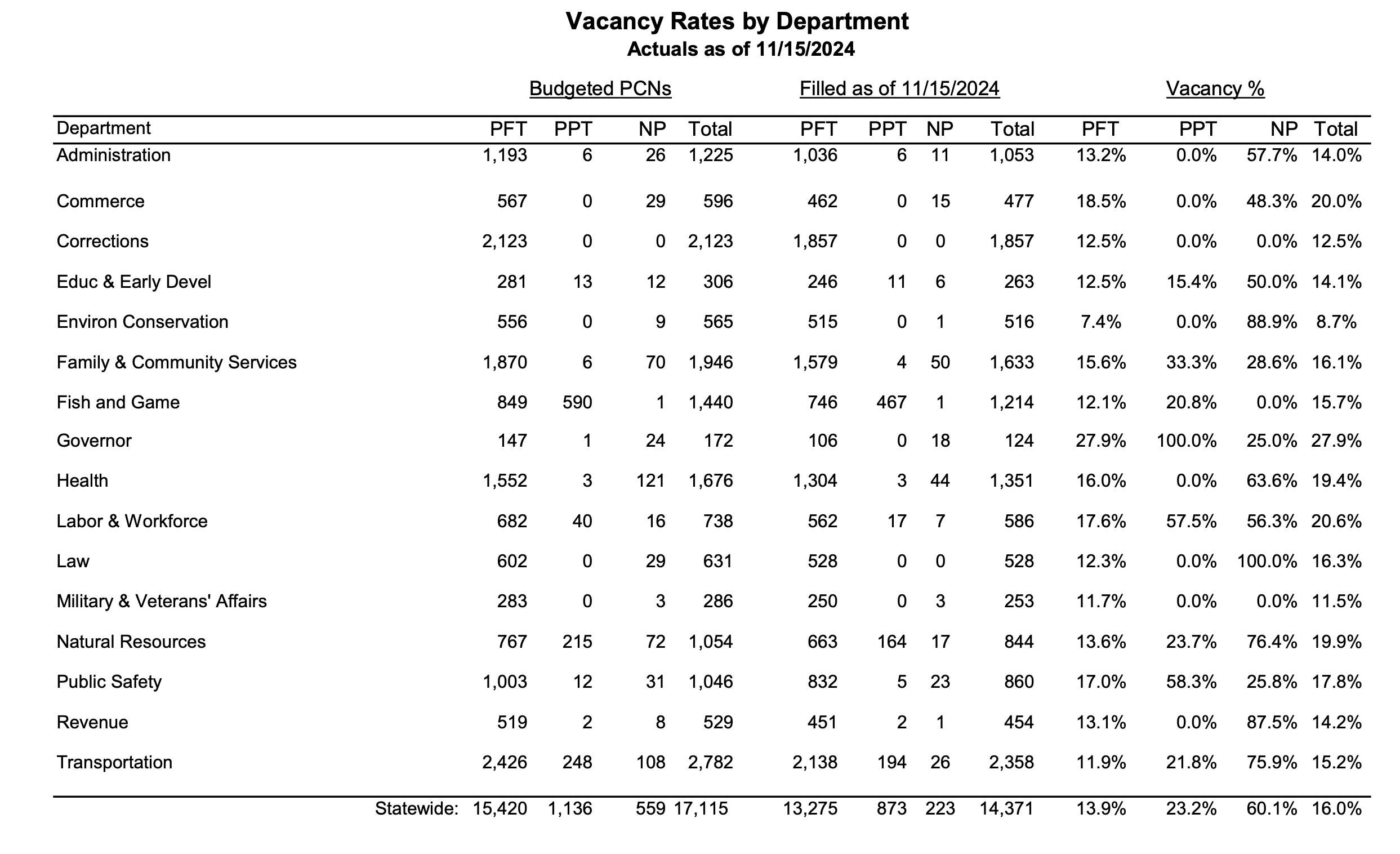
This chart, published by the Anchorage Daily News with data from the state budget office, shows a vacancy rate of 16 percent. PFT means permanent full time. PPT means permanent part-time. NP means non-permanent.
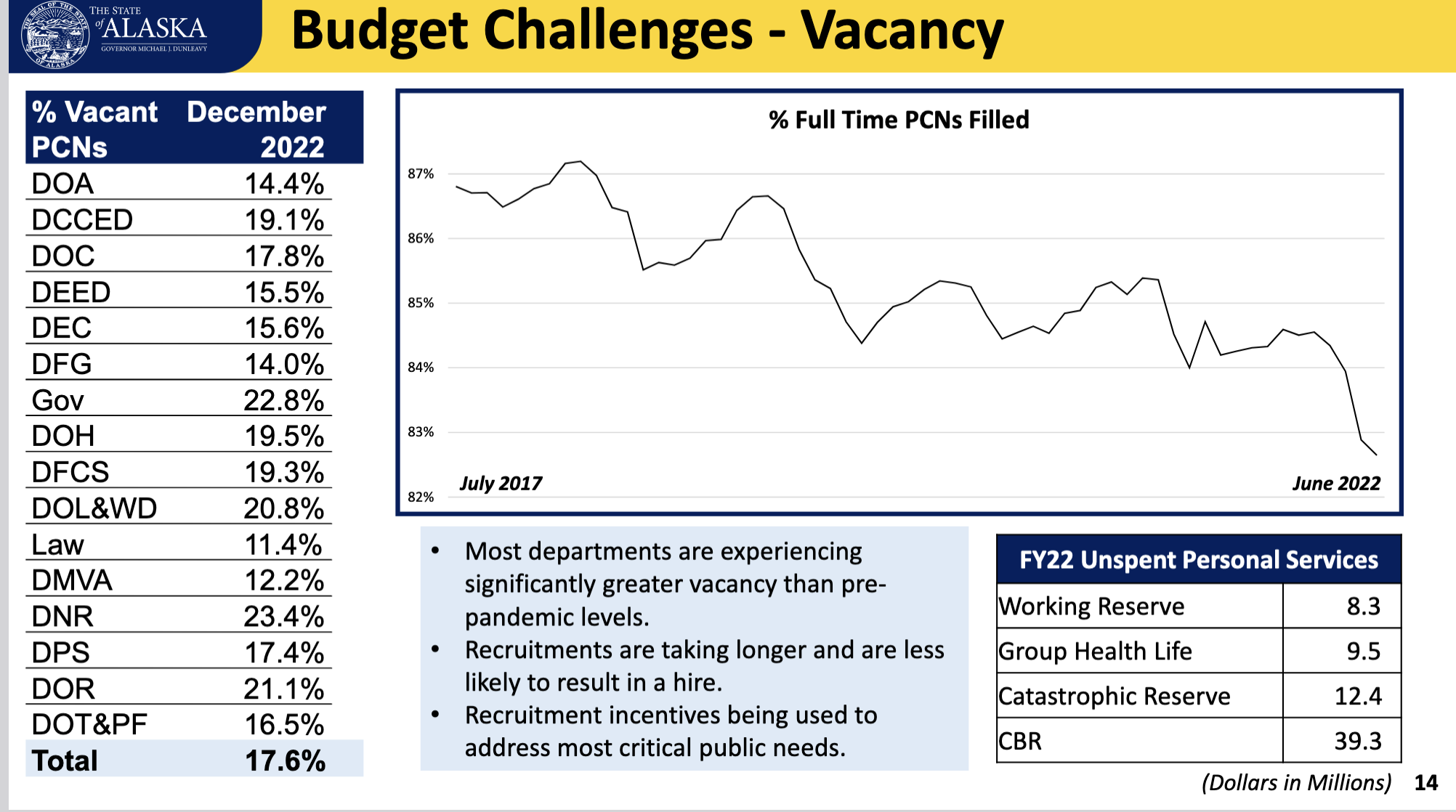
This is from a budget hearing nearly two years ago.