Bad idea of the year: Blindly increase subsidies for Cook Inlet natural gas. Again.
The oil tax for Cook Inlet is permanently capped at $1 a barrel. The natural gas tax for Cook Inlet is permanently capped at 18 cents per thousand cubic feet.
The miniscule state taxes are supposed to be an economic incentive to drill for more gas in Cook Inlet.
With the looming natural gas shortage and the prospect of importing natural gas to supply Alaska utilities, some Republican leaders say the obvious solution is to make the taxes more miniscule or eliminate them altogether.
It’s deja vu all over again. The strategy is to throw state money at the problem.
“Officials from Republican Gov. Mike Dunleavy’s administration have reviewed possible state incentive programs, like reduced taxes or royalties for Cook Inlet oil and gas companies, that could be proposed during next year’s legislative session, according to two of Dunleavy’s cabinet members,” Nat Herz reports in Northern Journal.
“Sutton Republican Rep. George Rauscher will also file his own legislation to eliminate taxes and royalty payments for new Cook Inlet gas discoveries, he said in an interview. Rauscher is the vice chair of the House Resources Committee, which has jurisdiction over oil and gas policy, and he’s also a member of his chamber’s GOP-led majority.”
The Dunleavy and Rauscher plan for corporate giveaways has been tried before. It’s not what Alaska needs.
I was glad to see that Anchorage GOP Sen. Cathy Giessel, co-chair of the Senate resources committee, had the good sense to say she’d need to see the numbers before another subsidy spree.
We need numbers, not more state handouts.
Before the state cuts or eliminates taxes and royalties, let’s see a clear accounting of how much money has gone to Cook Inlet subsidies. At what price did the state purchase energy supplies?
The basic approach was to cut taxes and allow the companies to do what they wanted. The state rarely demanded anything in return. It was better than Cash for Clunkers. And there was no effort to use the state’s leverage on behalf of Alaskans.
There are provisions in state law allowing a reduction in royalties if companies justify why a reduction is required. The companies hate that approach and would rather pull political levers to get elected officials to work on their behalf.
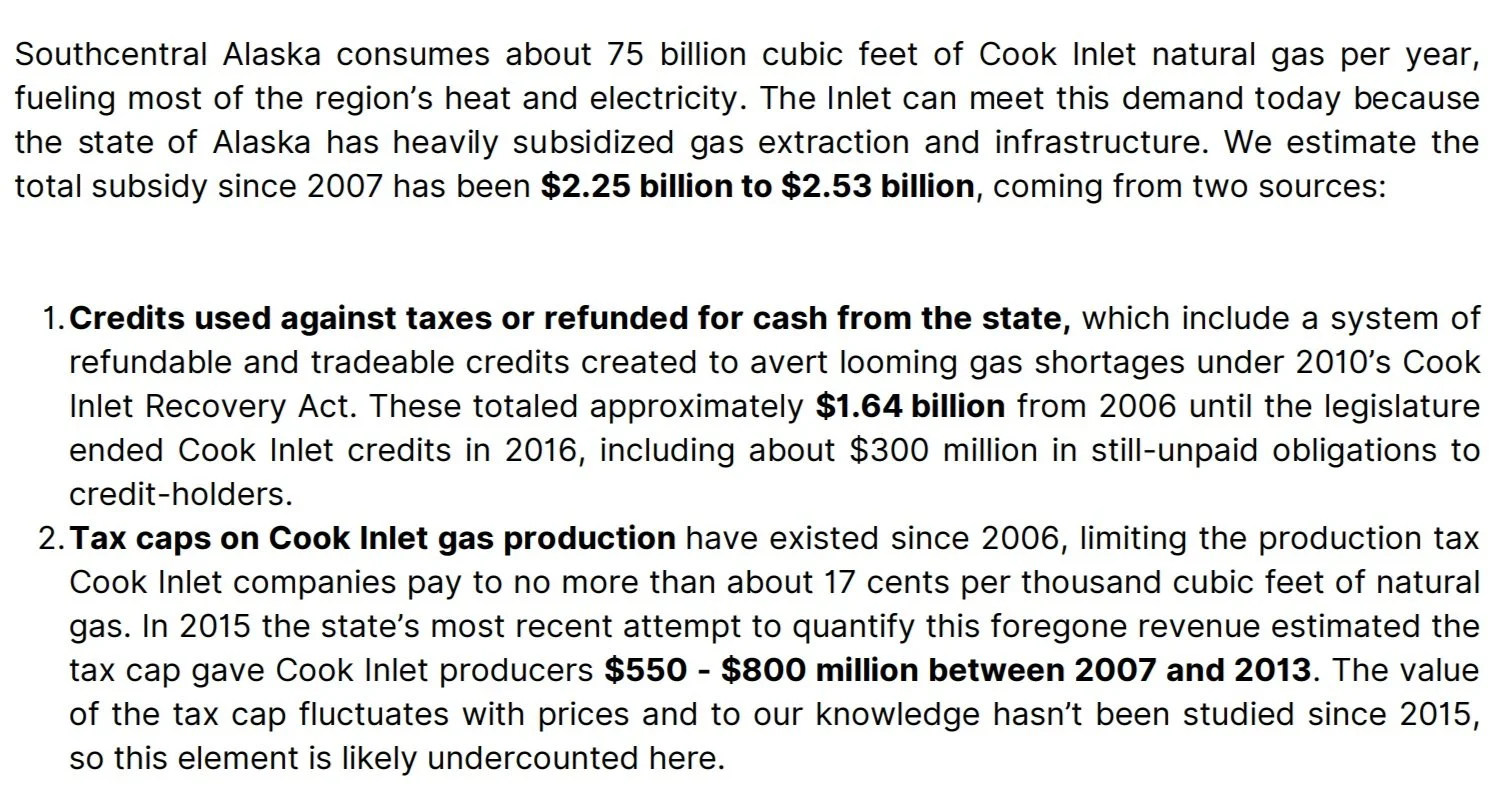
A 2022 report by the Alaska Public Interest Rearch Group estimated total Cook Inlet state subsidies of $2.2 billion to $2.5 billion since 2007.
Those are staggering statistics, but just estimates because so much information is treated by the state as secret.
The state has been shy about analyzing what it gave away to the oil and gas companies for what a decade ago everyone was calling the “Cook Inlet Renaissance” created by state subsidies.
“Cook Inlet's renaissance kicked into high gear, with hundreds of millions of dollars in private-sector spending in 2012,” future Sen. Dan Sullivan beamed in 2013, when he was natural resources commissioner under Gov. Sean Parnell.
“Companies launched a new gas storage facility and brought two jack-up rigs to the Inlet for the first time in history. Two years ago many Alaskans believed the Cook Inlet basin was effectively dead. Now, at least 10 oil and gas wells are being drilled, we've seen record lease sales and world-class companies like Apache and Hilcorp are investing hundreds of millions,” Sullivan said.
It was a premature victory dance.
Yes, there were lavish state subsidies for the jack-up rig competition and what followed were bankruptcies, excessive payments to companies that had little production and higher prices for consumers.
Those who mention the Renaissance now are talking about the 16th Century. The Cook Inlet version was a boondoggle, made worse because legislators and governors failed to pressure private firms while giving them piles of cash.
What is Hilcorp, former renaissance leader, now earning from its operations in Cook Inlet?
We don’t know. Texas billionaire Jeff Hildebrand, owner of Hilcorp, doesn’t pay the corporate income tax the other giant companies pay because of a defect in state law. The law was written at a time when publicly-owned companies controlled the industry in Alaska. Elected officials did not envision a renaissance man like Hildebrand and did not require the tax for his particular corporate structure.
Close the $100 million Hilcorp loophole and then look at the numbers and the future energy supply in Alaska, including alternatives. Smart investors ask questions and gather information. The state needs to be a smart investor for a change.
Here is the summary from the Alaska Public Interest Group on the giveaway programs of the past. The full report is here.
Your contributions help support independent analysis and political commentary by Alaska reporter and author Dermot Cole. Thank you for reading and for your support. Either click here to use PayPal or send checks to: Dermot Cole, Box 10673, Fairbanks, AK 99710-0673.